Eyeliner manufacturing splits into three formats with three different failure modes: a pencil that drags or crumbles, a gel pot that dries out, and a liquid that cracks or smudges. Each format is judged on the same two properties – a line that draws smoothly and a line that stays where it was placed – and each achieves them by a different mechanism.
1. The pencil
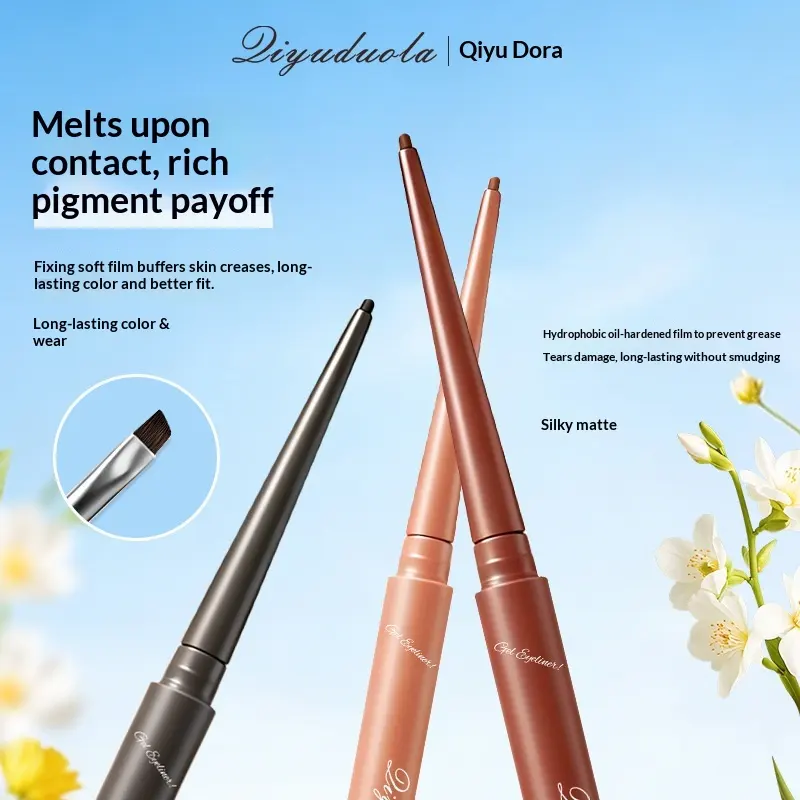
A pencil is a wax and oil core in a wood or plastic barrel. The hardness is set by the wax ratio: too hard and it drags and tugs the lid; too soft and it crumbles and the tip flattens in one use. A typical core is 25 to 35 percent wax, with a soft wax for glide and a hard wax for structure, plus pigment at 10 to 20 percent and a small amount of a silicone for slip. A sharpener-compatible pencil needs a core that does not shatter at the point.
2. Gel liner
A gel pot is an anhydrous or low-water gel with a high pigment load, applied with a brush. It gives the sharpest line and the strongest colour, and it dries out if the pot is left open. The formula needs a volatile component for a quick set and an emollient for glide, which are opposing requirements; the ratio decides whether the liner smudges during application or sets too fast to blend.
3. Liquid liner
A liquid liner is a water or alcohol-based film former with pigment, applied with a felt tip, a brush or a pen. It gives the most precise line and the strongest wear, and it cracks if the film is too rigid or smudges if the pigment load is too high for the film to hold. An acrylic or a polyurethane film former at 8 to 15 percent is typical; the applicator decides whether the line is easy to draw, which is why the pen format dominates the mass market.
4. The wear test
Draw a 3 cm line on the eyelid of twelve subjects, incubate at 37 degrees Celsius for 8 hours, and score smudging, fading and flaking on a 0 to 3 scale. Photograph at 2, 4 and 8 hours. A pencil that smudges at hour two is normal and acceptable for a smoky look; a liquid that flakes at hour four is a defect. Test in a humid room as well, because humidity is what separates a good liner from a great one in tropical markets.
5. Eye safety and preservation
All three formats are eye-area products, so the safety assessment has to cover the ocular route and the preservative system has to be validated. A pencil is low risk because it is anhydrous; a gel and a liquid carry water and need a challenge test. A liquid liner that is not preserved adequately is the highest-risk product in the category, because the applicator touches the lash line and returns to the reservoir.
6. Waterproof claims
A waterproof claim requires a measured test: draw the line, immerse in water for 20 minutes, and score retention. A liner that retains 80 percent of its intensity after immersion can carry the claim; one that retains 50 percent should be described as water-resistant or long-wear instead. The distinction matters because consumers interpret waterproof as swim-proof.
7. Commercial profile
Gel pot liner, 3 g jar, MOQ 3,000 units, 30 to 40 days. See the eye makeup range and the mascara guide for the product that completes the eye look.