Lip patch flavours are the part of the brief that arrives first and gets validated last. A brand picks strawberry because the reference product is strawberry, then discovers at month four that the natural colour has browned, the flavour has migrated into the sachet film, or the fragrance level produces tingling on a small share of users. Flavour is a formulation input with a stability cost, not a marketing line.
1. The four that reliably sell
Strawberry, peach, avocado and honey. Strawberry is the volume leader in Asia and the US; peach performs in Japan and Korea; avocado is the strongest in the clean-beauty segment because the fruit reads as nourishing; honey sells in Europe and in gift sets. All four are available as concentrated flavour oils and as powder extracts, and the powder route is usually better for a hydrogel because it disperses rather than emulsifies.
2. Flavour load
Detectable taste in a hydrogel needs far less than most briefs assume: 0.05 to 0.15 percent of a concentrated oil, or 0.2 to 0.5 percent of a powder extract. At 1 percent the flavour destabilises the gel network, softens the patch and produces an oily surface that will not adhere. A sweetener – a glycoside or a sugar alcohol – carries most of the perceived sweetness, and the flavour carries the identity.
3. Colour, and why natural colours fail
| Flavour | Typical colour | Risk at 40°C over 3 months |
|---|---|---|
| Strawberry | Red-pink | Fades to salmon |
| Peach | Warm orange | Browns |
| Avocado | Pale green | Yellows, loses green |
| Honey | Amber | Darkens |
Fruit-derived colours are the most sensitive, because anthocyanins and carotenoids oxidise. A lake pigment or a cosmetic-grade iron oxide is far more stable, and most retail products use one and describe the flavour rather than the fruit. If the brief requires a natural colour, the shelf life has to be shortened or the pack has to be opaque.
4. Shapes beyond the double lobe
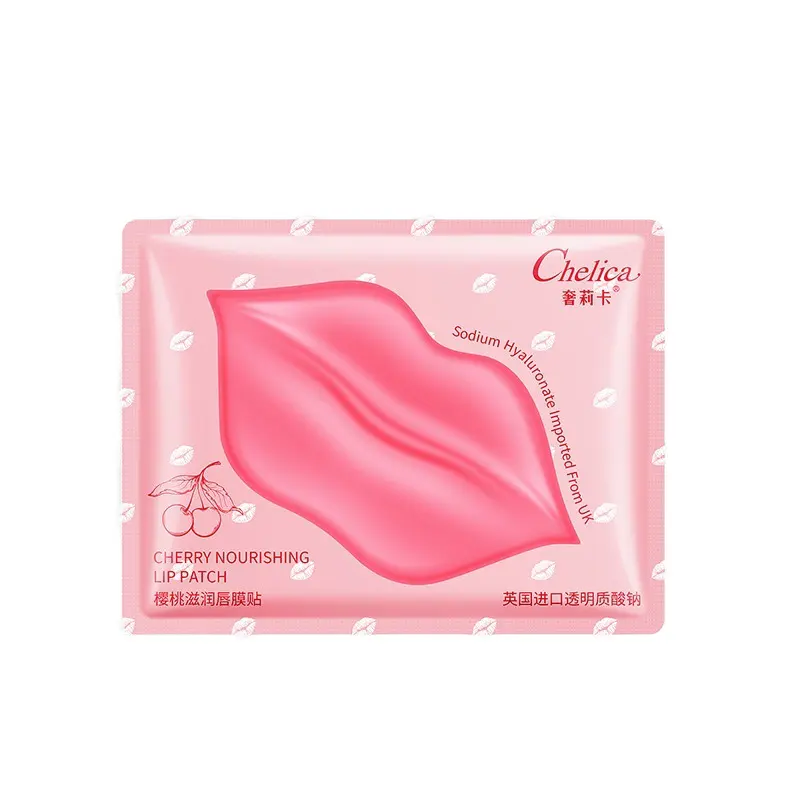
The double-lobed full-lip patch is standard. A lower-lip-only patch is the fastest-growing variant because it is comfortable enough for overnight use. A small heart or a lip-shaped patch with a printed smile is a gift and photo format. A corner patch for the commissures is a niche product for very dry lips. Custom dies cost a one-off charge and two to three weeks, and every shape has to be adhesion-tested on ten subjects.
5. Irritation and restricted materials
Menthol gives a plumping sensation and is restricted or discouraged in lip products in several markets. Cinnamon, clove and citrus oils are sensitisers above trace levels. Peppermint at 0.05 percent is tolerable; at 0.3 percent it produces a burning report in a minority of users. If a brand wants a cooling sensation without the risk, a low level of a cooling agent such as a menthyl derivative, or simply a chilled sachet, is the better answer.
6. Testing the flavour, not just the gel
- Sensory panel at 0, 3 and 6 months, blind, with a 1 to 5 intensity score.
- Colour measured by a spectrophotometer at the same intervals.
- Flavour migration into the sachet film, checked by odour after storage.
- Patch adhesion after storage, because a softened gel behaves differently.
- Skin tolerance on 30 subjects, including two with a history of lip sensitivity.
7. Commercial profile
Stock flavour, stock die, MOQ 2,000 pairs, 25 to 35 days. A new flavour adds four weeks. See the lip mask range, and the seasonal planning guide if you are building a set.