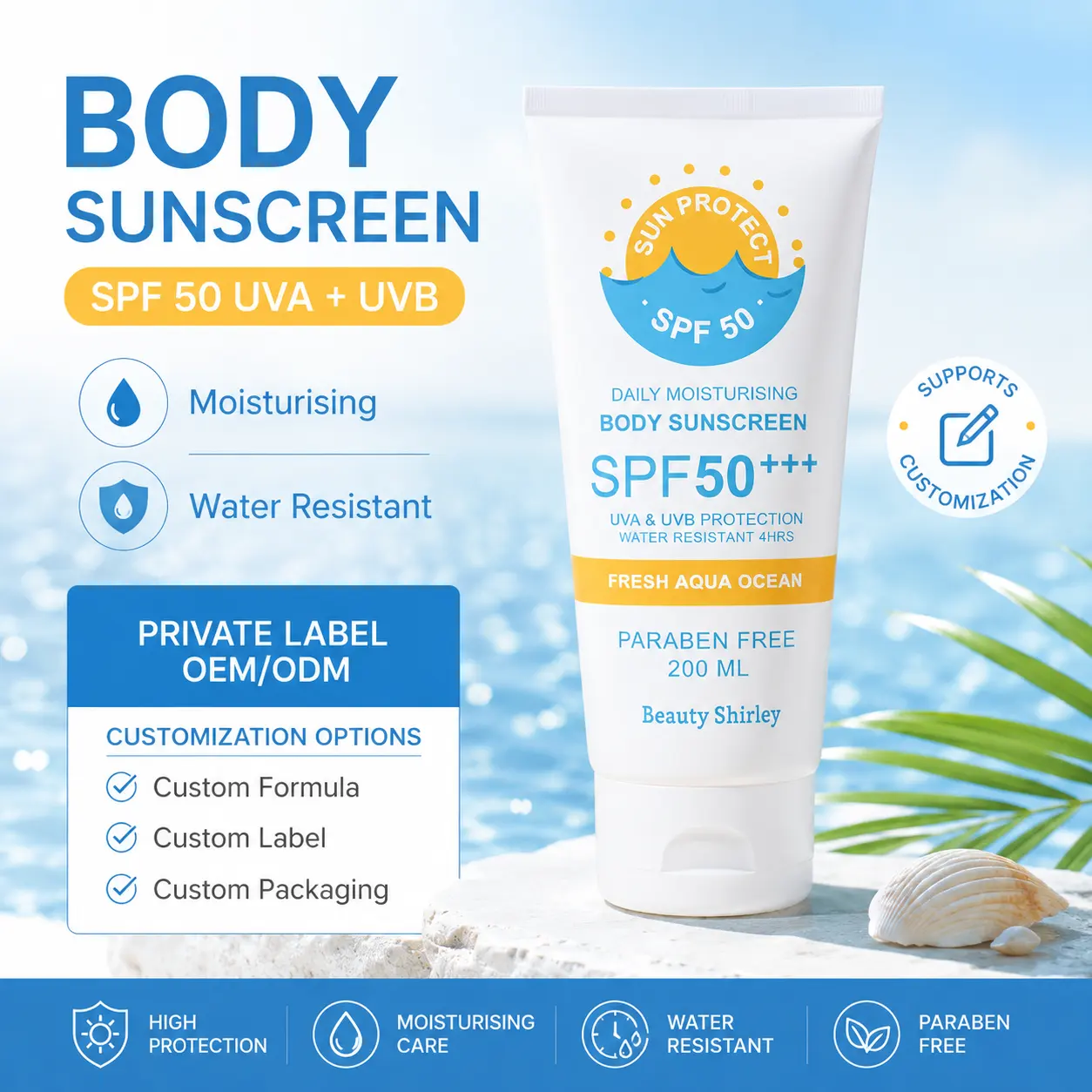
Sunscreen stick OEM is the fastest-growing format in sun care, driven by three consumer behaviours: reapplying on the move, avoiding the hand-to-face transfer of a cream, and carrying a product through airport security. The format is anhydrous – wax, oil, ester and filter – which removes the preservative problem entirely and replaces it with a mechanical one: a stick that softens in a hot car and then cannot be applied evenly.
1. Structure
A stick is 15 to 25 percent wax, 30 to 45 percent emollient oil and ester, 15 to 30 percent UV filter and 1 to 5 percent film former and powder. The wax blend decides the structural integrity: a hard wax such as a synthetic polyethylene for heat resistance, a soft wax for glide, and a small amount of a butter for feel. A stick that is too hard drags on the skin and delivers an uneven film; a stick that is too soft collapses at 35 degrees Celsius.
2. The heat test that matters
Test a filled stick at 45 degrees Celsius for 48 hours, upright and on its side, and inspect for lean, sag and oil pooling at the base. In-use conditions include a car dashboard at 60 degrees Celsius, so the 45-degree test is a minimum, not a target. A stick that passes at 45 and fails at 55 is a product to sell in temperate markets only, and that has to be a decision rather than an accident.
3. Delivery and the film thickness problem
SPF depends on 2 mg per square centimetre of product on the skin. A stick applied like a deodorant delivers far less, which is why in vivo testing of a stick has to use the real application gesture, not a smeared 2 mg dose. Several stick products print SPF 50 and deliver SPF 15 in real use. A responsible brand tests the stick as a stick and, if it cannot reach the printed value, prints a lower number and instructs two passes.
4. Filters that work without water
In an anhydrous base, inorganic filters disperse rather than dissolve, and coated zinc oxide or titanium dioxide at 15 to 25 percent is the usual route. Organic filters are oil-soluble and work well, but the permitted list differs sharply by market, and a stick formulated for the US cannot be sold in the EU without reformulation. Check the filter list per market before the base is developed.
5. Packaging
A stick needs a twist or a push-up mechanism, a cap that seals, and a barrel that does not deform at 50 degrees Celsius. A cardboard barrel is recyclable and popular in the clean segment, but it swells with oil over time; a paper barrel needs an inner liner. A wide 25 to 30 mm stick delivers faster than a narrow 15 mm stick and is the better choice for body use.
6. Testing and claims
- In vivo SPF using the real application gesture.
- Water resistance if claimed, tested after immersion.
- Heat stability at 45 and 55 degrees Celsius.
- Uniformity of film, measured by a trained assessor or by UV imaging.
- Compatibility with the barrel, including a 30-day inverted hold.
7. Commercial profile
Stock stick barrel, 15 g fill, MOQ 3,000 units, 30 to 40 days after the formula and the SPF test are complete. See the sunscreen range and the emulsion guide if you are comparing a stick with a cream.