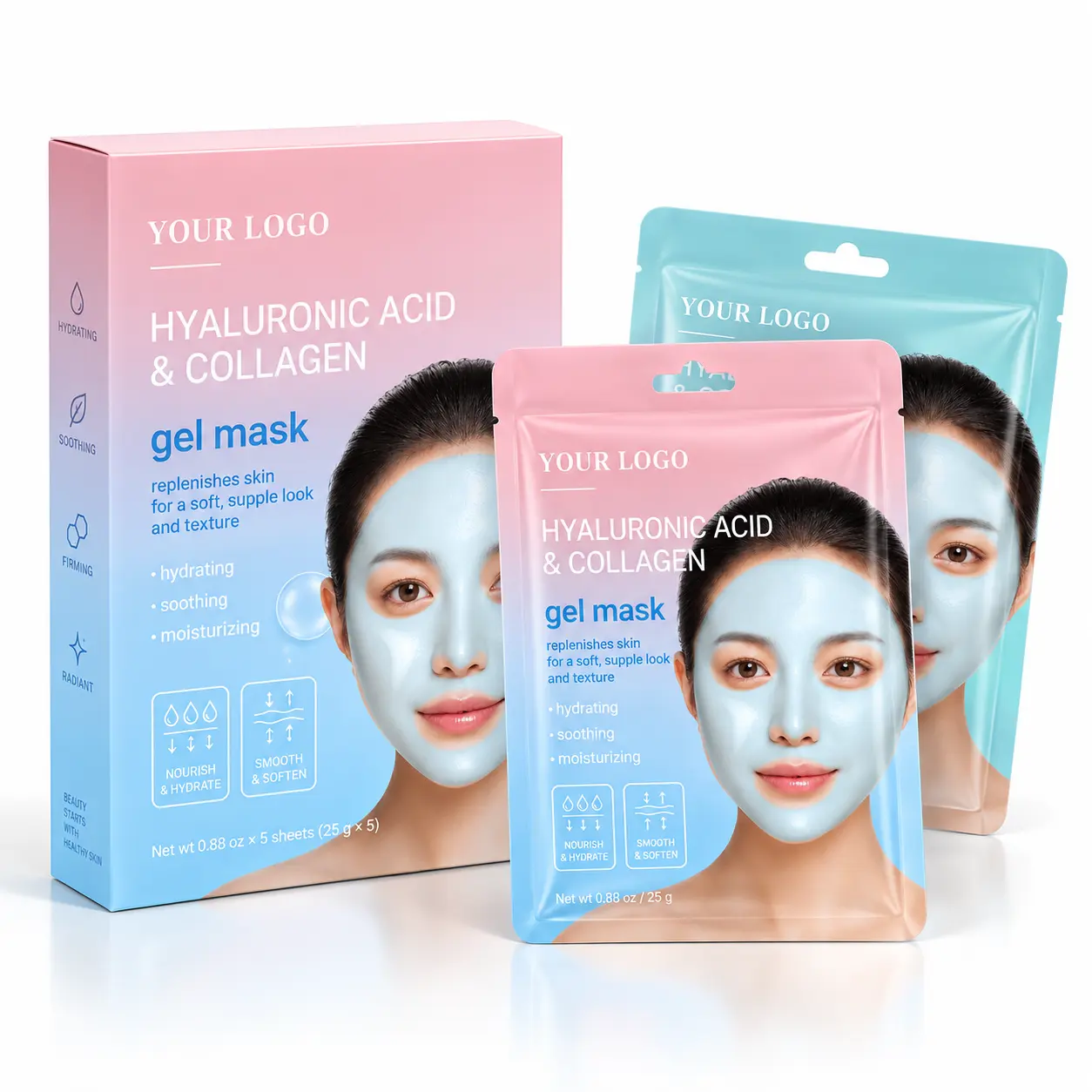
Cream facial mask sits between a moisturiser and a treatment, and that awkward middle position is what makes it hard to formulate well. It has to be rich enough to feel like a treatment, light enough to rinse cleanly, and stable enough to sit in a sachet for two years without splitting. Most failed launches in this category split in the sachet, not on the face.
1. The oil phase and the rinse question
A cream mask carries 15 to 30 percent oil. Too much, and the product leaves a film that requires a second cleanse, which customers resent. Too little, and it dries on the skin within ten minutes and feels like a clay mask without the benefit. A workable blend is 8 to 12 percent of a light ester, 5 to 8 percent of a triglyceride, 2 to 4 percent of a fatty alcohol for body, and 1 to 2 percent of shea or a similar butter for richness. Silicone at 1 to 3 percent improves slip and rinse-off behaviour.
2. Emulsifier pairs, not single emulsifiers
A single emulsifier produces a cream that is stable at 25 degrees Celsius and fails at 40. The practical approach is a pair: a high-HLB non-ionic such as a polysorbate or a PEG-free glucoside at 2 to 3 percent, plus a low-HLB co-emulsifier such as glyceryl stearate at 1.5 to 2.5 percent, and a fatty alcohol to build lamellar structure. That combination gives a cream that survives a sachet seal at 180 degrees Celsius for a fraction of a second, which is the real test in this format.
3. Fill temperature decides your sachet life
Sachets are hot-filled at 45 to 60 degrees Celsius for cream masks, and the product must still be pourable at that temperature without phase separation. A cream that is perfect at room temperature and grainy at 55 degrees will produce a batch with a sandy texture that no stability test catches, because the defect forms during filling, not during storage. We run a fill simulation in the pilot plant before scaling, and we hold the filled sachet at 40 degrees Celsius for 24 hours to check for separation at the seal.
4. Actives that suit a 15-minute contact
Cream masks are a short-contact vehicle, so the useful ingredients are the ones that act on the surface: humectants, ceramides, panthenol, a low level of niacinamide, and emollients that improve immediate softness. Strong acids and high-dose retinoids do not belong here. Botanical extracts are mostly a story unless they are standardised, and a standardised extract with a stated marker compound is worth the price difference when a claim is printed on the front.
5. Format comparison
| Format | Fill | Cost per unit | Best for |
|---|---|---|---|
| Sachet | 8 to 15 ml | Lowest | Single-use retail, travel, sampling |
| Tube | 50 to 100 ml | Medium | Repeat purchase, bathroom shelf |
| Jar | 100 to 200 g | Highest | Premium gift, spa |
6. Testing
Standard stability at 25 and 40 degrees Celsius with viscosity, pH and microscopy at each pull. A sachet-specific test: seal integrity after 48 hours inverted, plus a 40 degrees Celsius hold on the packed unit. And a rinse-off sensory panel, because how a cream mask rinses is the experience the customer remembers.
7. Commercial profile
Stock cream base, 10 ml sachet or 60 ml tube, MOQ 1,000 sachets or 500 tubes, 25 to 35 days. See the cream facial mask range and, for the emulsion fundamentals that apply to creams more broadly, the day and night cream comparison.




