Travel capsule serum sets are the cheapest honest sampling tool a skincare brand has. A seven-bead card costs a fraction of a 5 ml mini bottle, delivers exactly seven doses, and cannot be spilled in a wash bag. The format is also the most common place where brands get the merchandising maths wrong: they build the pack they like rather than the pack that converts.
1. The common counts and why they exist
Seven, fourteen, and thirty beads are the three that sell. Seven maps to a one-week trial and fits a card. Fourteen maps to a two-week routine test, long enough for a consumer to notice a texture or a hydration change. Thirty maps to a full month and is usually sold as a travel jar rather than a sample. Anything between these numbers reads as arbitrary and slows the buying decision.
2. Card, jar or tin
| Format | Best use | Cost profile | Risk |
|---|---|---|---|
| Printed card with blister | Sampling, magazine inserts | Lowest | Beads can be crushed in post |
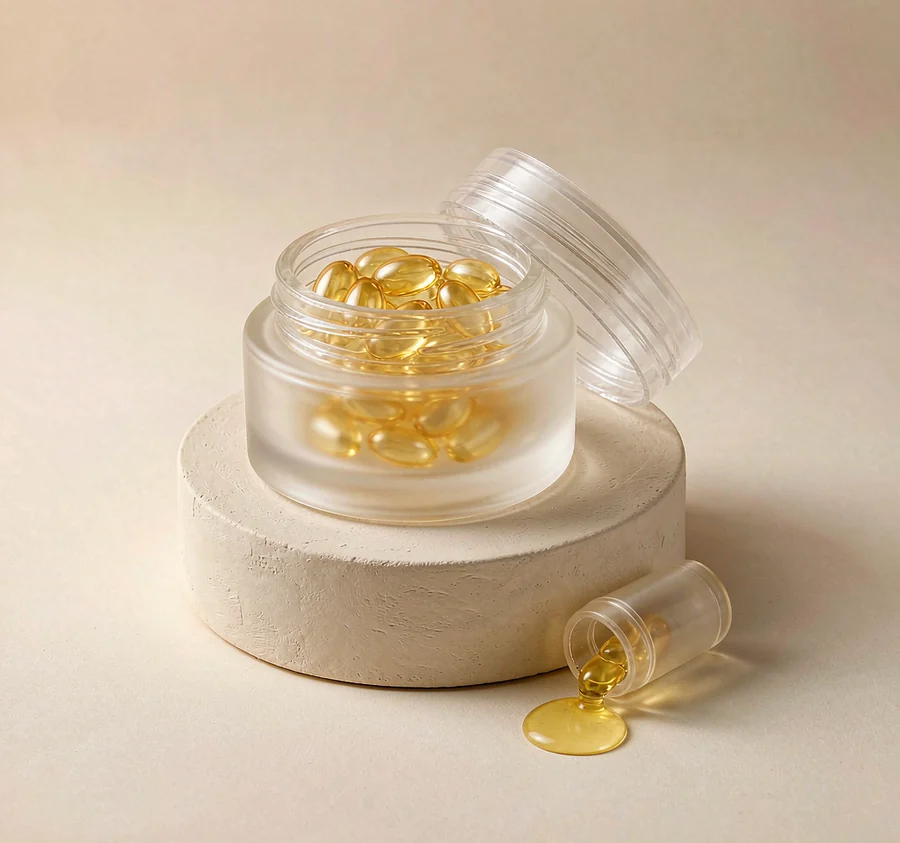
| Clear PET jar, 15 to 30 beads | Travel retail, gift with purchase | Low | Needs a dosing instruction |
| Aluminium tin | Premium gift sets | Medium | Tin liner must be odour-free |
| Multi-item kit box | Holiday sets | Highest | Assembly and pick-pack labour |
3. Dieline discipline
Every extra millimetre of card is money at 20,000 units. A seven-bead card usually runs on a 60 by 90 mm footprint with a 0.4 mm board; the blister cavity has to be deep enough that the bead does not sit under the fold. The single most common packaging failure we see is a card whose blister depth was copied from a 0.5 ml bead and reused for a 1.0 ml bead, so the top bead sits proud and gets crushed in the mailer.
4. Unit economics at low volume
At 1,000 units a seven-bead card is a viable sampling SKU; below 500 the print setup dominates the cost. At 10,000 units the card becomes cheap and the fill becomes the cost driver. Brands should model the fully loaded cost per trial – bead, card, print, pick-pack, freight – and compare it with the cost per trial of a 5 ml bottle. The capsule card usually wins by a factor of two to four, which is the entire argument for the format.
5. What to print on a trial pack
- One benefit, one sentence. A trial pack that lists six benefits tests nothing.
- The full-size equivalent: seven beads equals seven nights, not seven millilitres.
- A QR code to the full-size product page, with the same batch code range.
- Break-open instructions as a pictogram, because half of first-time users squeeze the wrong end.
6. Filling and assembling at the same plant
When the beads and the card come from the same facility, the sample ships in the same production window as the full size and the batch traceability stays in one document set. That is worth more than a small unit-cost saving: a sample batch that cannot be traced back to a bulk lot is a recall problem waiting to happen. Ask whether the assembly is done in a GMP area with its own line clearance record.
7. A workable first order
Seven beads, 0.5 ml fill, printed card, MOQ 1,000 cards, 3 to 4 weeks after artwork approval. A jar version starts at 500 pieces and 25 to 35 days. See the travel and disposable capsule set range for stocked configurations, and the private label cost breakdown for how the sampling pack changes the launch budget.