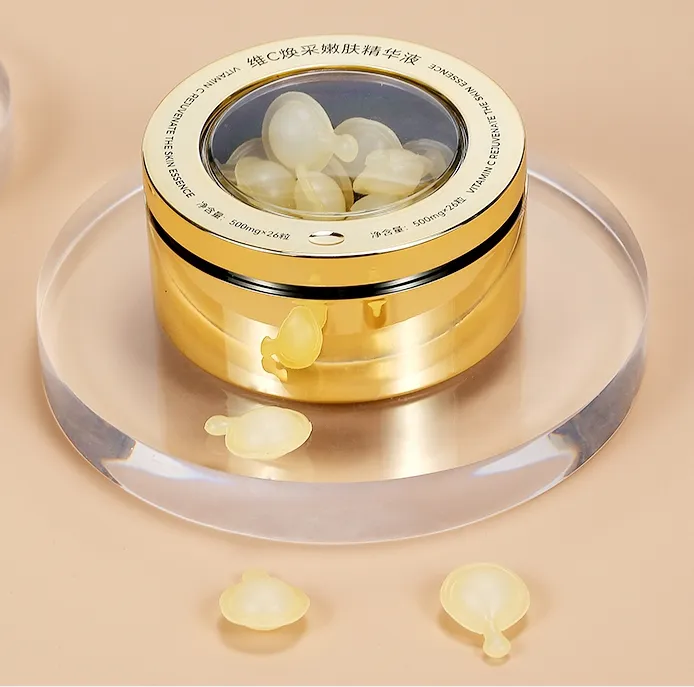
Retinol capsule serum OEM projects fail for one reason more often than any other: the active is dosed correctly on day one and half gone by month twelve. Retinol oxidises, isomerises under heat, and degrades in the presence of light and trace metals. A single-dose capsule removes two of those four stressors outright, which is why the format has become the default for brands that want a defensible retinol claim without moving to a prescription-style product.
1. Why the capsule is a better container than a bottle for retinol
In a dropper bottle the headspace above the liquid is renewed every time the cap opens: oxygen enters, the retinol consumes it, and the next opening brings more. In a sealed bead there is no headspace to renew. Our filled beads sit at less than 2 percent residual oxygen when the fill is done under nitrogen. That single difference typically buys twelve to eighteen months of additional shelf life at 25 degrees Celsius, and it is measurable rather than a marketing assumption.
2. Concentration: the range that actually works
Encapsulated retinol in a capsule serum usually runs 0.05 to 0.3 percent, with 0.1 percent the most common retail dose and 0.3 percent the practical ceiling for a mass-market product. Above that, irritation complaints rise faster than perceived efficacy, and in the EU the product may need a different labelling path. We recommend brands start at 0.1 percent, run a 12-week consumer perception study, and only then decide whether a 0.2 or 0.3 percent line extension is worth the extra claim risk.
3. Encapsulation choices and what they cost
Three systems are in common use. Cyclodextrin complexes are the cheapest and give good heat protection but a modest water-release profile. Liposomal encapsulation gives the best skin delivery and the highest cost per kilogram. Polymeric microcapsules sit in the middle and are the easiest to run on a rotary die because they tolerate the shear at the fill nozzle. Whatever system you choose, ask for the release assay: a capsule that never releases the retinol is a very stable and completely useless product.
4. The formula around the active
The base has to be built to protect the payload. That means a chelating agent to bind trace metals, a low-water or anhydrous base where possible, an antioxidant pair such as tocopherol with a co-antioxidant, and no pH-driven gelling system that forces the retinol into an unstable window. Fragrance and citrus oils are avoided: both accelerate degradation and both are common causes of a formula that tests well in month one and fails in month six.
5. The stability file a buyer should demand
| Test | Condition | What it proves |
|---|---|---|
| Accelerated | 40 degrees Celsius, 75 percent RH, 3 months | Packaging and emulsion integrity |
| Real time | 25 degrees Celsius, 24 months | Retinol assay at 0, 6, 12, 24 months |
| Cycling | -10 to 45 degrees Celsius, 3 cycles | Freight and warehouse swings |
| Light | ICH option 2, 120 hours | Whether the jar needs an opaque outer |
The assay is the line that matters. A stability summary that reports colour and odour but not the retinol percentage is a packaging report, not a product report.
6. Packaging and the claim on the front of the jar
Even with beads, the jar is part of the system. An amber or opaque jar with a tight seal keeps the beads below 30 degrees Celsius in transit. If you intend to print a retinol percentage on pack, the number has to be the label claim value with a documented tolerance – typically 90 to 110 percent of declared at end of shelf life – not the amount you poured into the tank. This is the single most common compliance gap we see in private-label retinol launches.
7. A realistic schedule for a first run
Formula selection from our stock anti-aging bases takes one to two weeks. Sampling and a 12-week accelerated run take three months. Tooling, artwork and a first production batch add six to eight weeks. A brand planning a spring launch should be sampling in the previous autumn. The anti-aging and anti-wrinkle capsule range lists the bases we keep in stock; the notes on stabilising vitamin C in a bead cover the same principles for the other difficult active in this category.