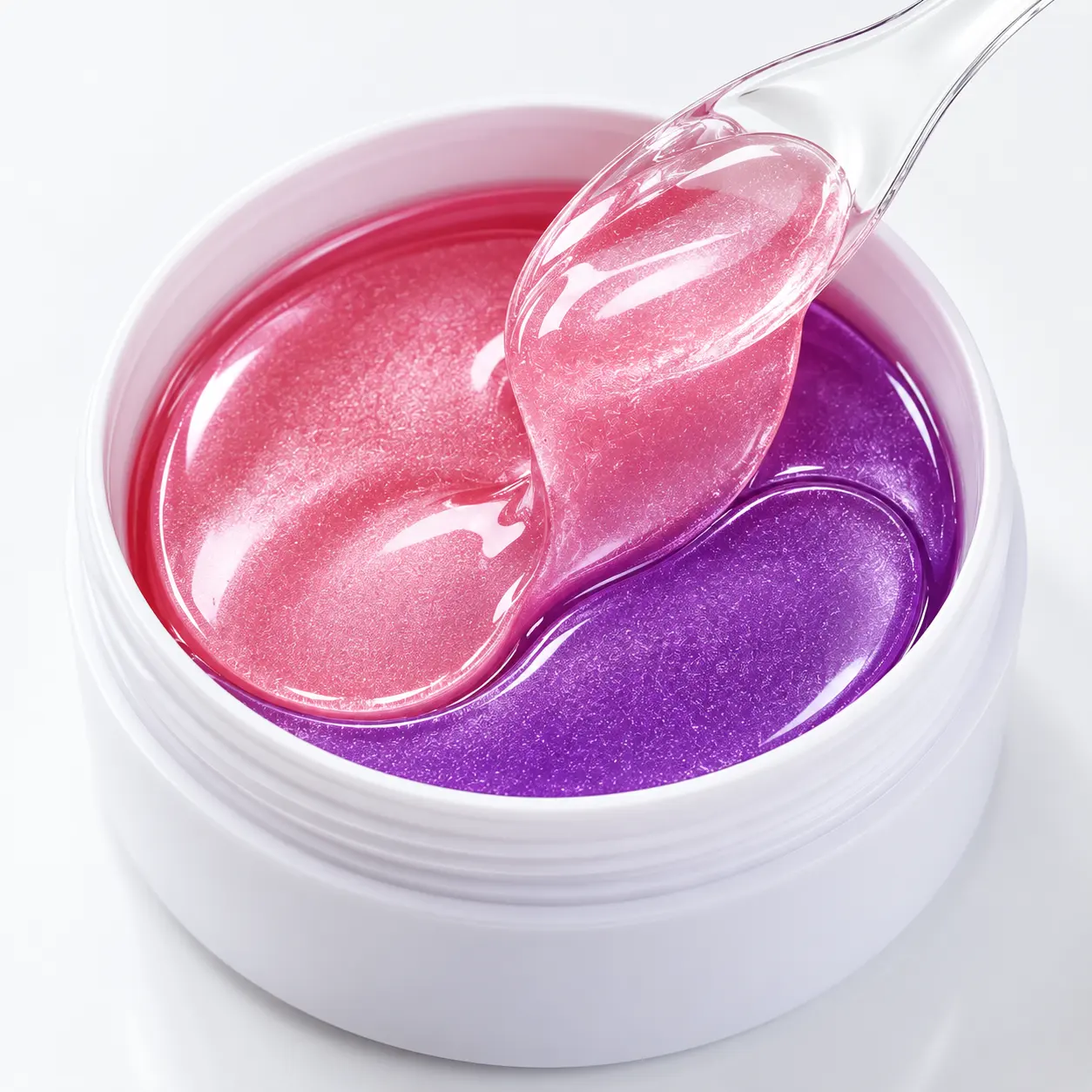
Mesh eye mask manufacturing is a thin-format play: a light, breathable patch with a visible grid structure, usually 0.3 to 0.6 mm thick, worn for 20 to 30 minutes. The mesh is not decorative. It distributes adhesive force across many small contact points rather than a continuous film, which makes the patch feel lighter and reduces the sensation of occlusion that some users dislike.
1. How the mesh is made
Three routes produce a mesh effect. A non-woven substrate with a printed grid pattern, which is cosmetic and cheap. An apertured film – a polyolefin film with a regular pattern of holes – which is genuinely breathable and the most common construction. And a hydrogel cast onto a mesh carrier, which gives a hydrated patch with visible structure and a premium feel. The first is a print, the second is a material, the third is a format. Ask which one is in the quote.
2. Breathability, measured not claimed
Moisture vapour transmission rate is the number that describes breathability, expressed in grams per square metre per 24 hours. An apertured film typically runs 800 to 2,000, a solid film under 200. A mesh patch that claims breathable but uses a solid film with printed holes is not breathable, and a test house will show it. If breathability is part of the position, request the MVTR from the material supplier.
3. Adhesive is the comfort variable
On a thin apertured film the adhesive has to be applied in a pattern, not a continuous coat, or the holes fill and the breathability disappears. A dot or lattice adhesive pattern at 40 to 60 percent coverage gives adhesion with open area intact. Acrylic adhesives dominate; a silicone adhesive is gentler on sensitive skin and more expensive. Peel force should sit at 0.3 to 0.8 newtons per 25 mm – enough to hold for 30 minutes, low enough to remove without resistance.
4. Where the format fits
A mesh mask is a good fit for daytime use, for oily skin that resists occlusion, and for markets where a heavy hydrogel feels too wet. It is a poor fit for a claim that depends on a large serum reservoir, because a thin apertured film holds 1 to 2 ml, not 5. If the brief is anti-wrinkle overnight, the mesh format will under-deliver no matter how good the serum is.
5. Serum loading on a thin substrate
The serum is usually applied to the film at 1 to 2 g per pair and the patch is packed in a sachet with a small residual volume. Because the film holds little, the serum viscosity has to be higher than for a hydrogel – otherwise it drains to the bottom of the sachet. A 300 to 600 centipoise serum sits well; a watery serum produces dry top edges.
6. Testing
- Adhesion on oily and dry skin, 30-minute wear, ten subjects.
- MVTR if breathability is claimed.
- Weight loss in sachet at 25 and 40 degrees Celsius.
- Skin tolerance, since thin films can crease and irritate at the inner corner.
- Seal integrity, as for any sachet format.
7. Commercial profile
Stock apertured film, 2 ml serum per pair, MOQ 5,000 pairs, 25 to 35 days. A hydrogel-on-mesh variant needs its own stability work and adds three weeks. See the mesh eye mask range, and the material comparison for how the mesh sits against hydrogel and collagen films.




