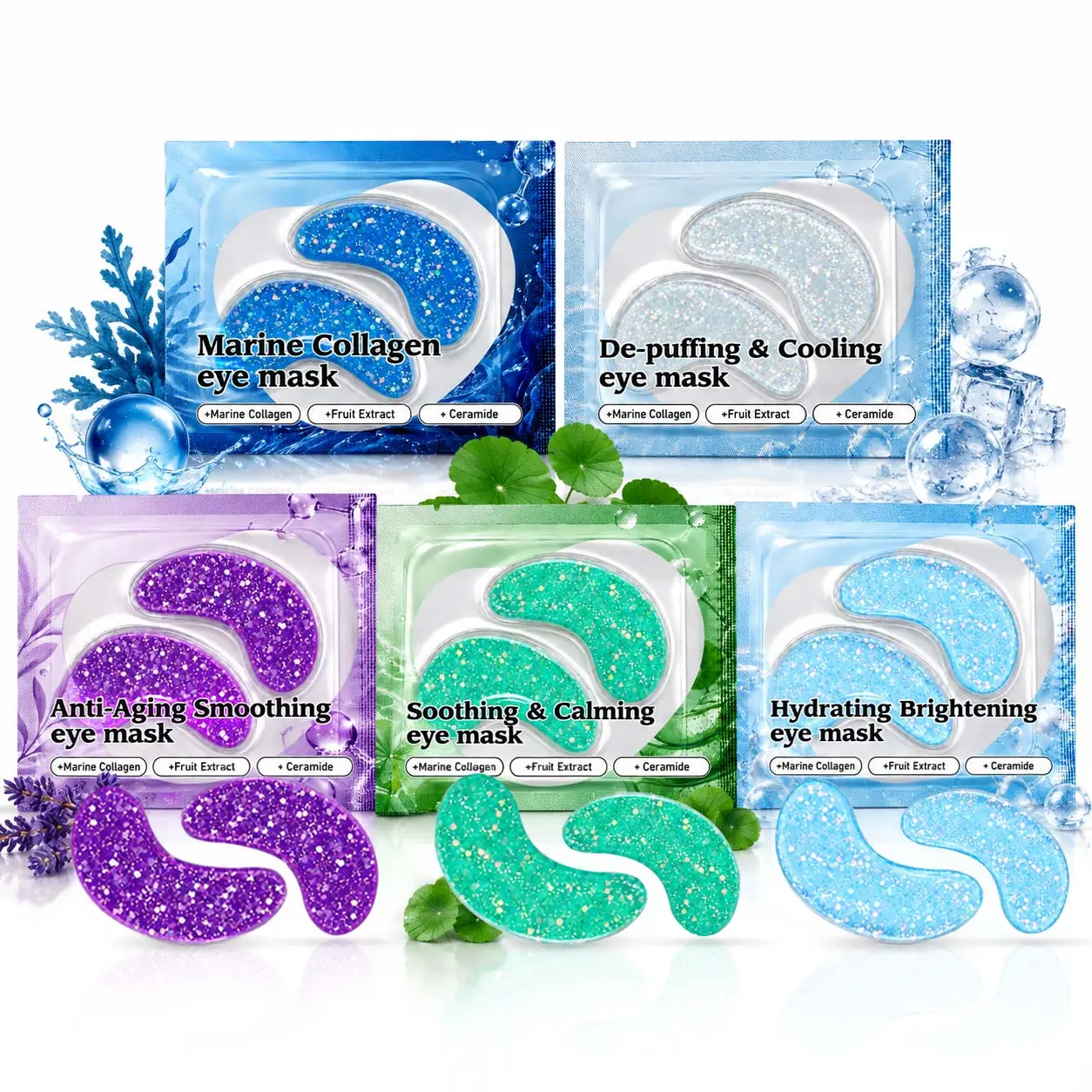
Eye patch private label projects fail on paperwork far more often than on product. The patch is usually the easy part – a stock gel, a stock die, a serum that has been made a thousand times. What goes wrong is a missing safety assessment, an artwork proof approved against the wrong die, or a claim printed before the supporting test was commissioned. This checklist is the sequence we run with brands, in order.
1. Define the format before the formula
Hydrogel, crystal collagen, bio-collagen, or mesh. Each has a different serum load, cost and claim ceiling. Deciding this first prevents the most expensive loop in the process: developing a serum for a format that cannot hold it.
2. Fix the claim, then commission the test
Write the front-of-pack sentence before sampling. If it says de-puffs in 20 minutes, the colorimetry and photography protocol has to be booked at the same time as the sample, because the test needs the final formula and the final pack. Claims commissioned after the production run delay the launch by the length of the study.
3. Select the shape and confirm the die
Stock shape or custom die. A custom die is two to three weeks plus a one-off charge and must be tested for adhesion on ten subjects. Lock the die revision in writing, because sachet artwork and the die must match.
4. Approve the sample from a production run, not a bench
A hand-filled laboratory patch behaves differently from a form-fill-seal patch: the seal, the serum distribution and the edge taper all differ. Insist on a sample from a qualification run.
5. Complete the compliance file
- Safety assessment or CPSR with the assessor’s credentials.
- GMP certificate (ISO 22716) and the facility registration for the destination market.
- Ingredient compliance review for each market, including allergen declaration in the EU.
- Stability summary covering weight loss, adhesion and microbiology.
- Challenge test per ISO 11930 where the formula contains water.
- Claims substantiation dossier, separate from the safety file.
6. Artwork and pack proof
The proof has to be checked against four things: the die, the fill weight, the ingredient list, and the claims dossier. A proof that says 60 patches on a jar that holds 58 is a reprint. A proof that names an ingredient not in the formula is a recall risk.
7. Label, carton and transit
Confirm the label application method, the carton dimensions against a pallet plan, and the master carton count. Eye patch jars are heavy for their volume, and a carton that wastes 8 percent of a pallet costs more than the label upgrade.
8. First production run and hold-back
Attend or request a video of the first run. Retain a hold-back sample of at least 12 units, sealed, with the batch record. It is the only reference you will have if a customer reports a defect six months later.
9. Release documents
Certificate of analysis, certificate of conformity, and a signed batch record summary. A shipment without these is a shipment a distributor cannot receive into a regulated warehouse.
10. The realistic timeline
Stock format with a stock claim: 8 to 11 weeks. Custom shape or custom serum: 16 to 24 weeks. Claims study in parallel: add 6 to 10 weeks, or run in parallel from the sample stage to absorb it. The eye patch range lists the stocked formats, and the claims guide explains what the dossier has to prove.




