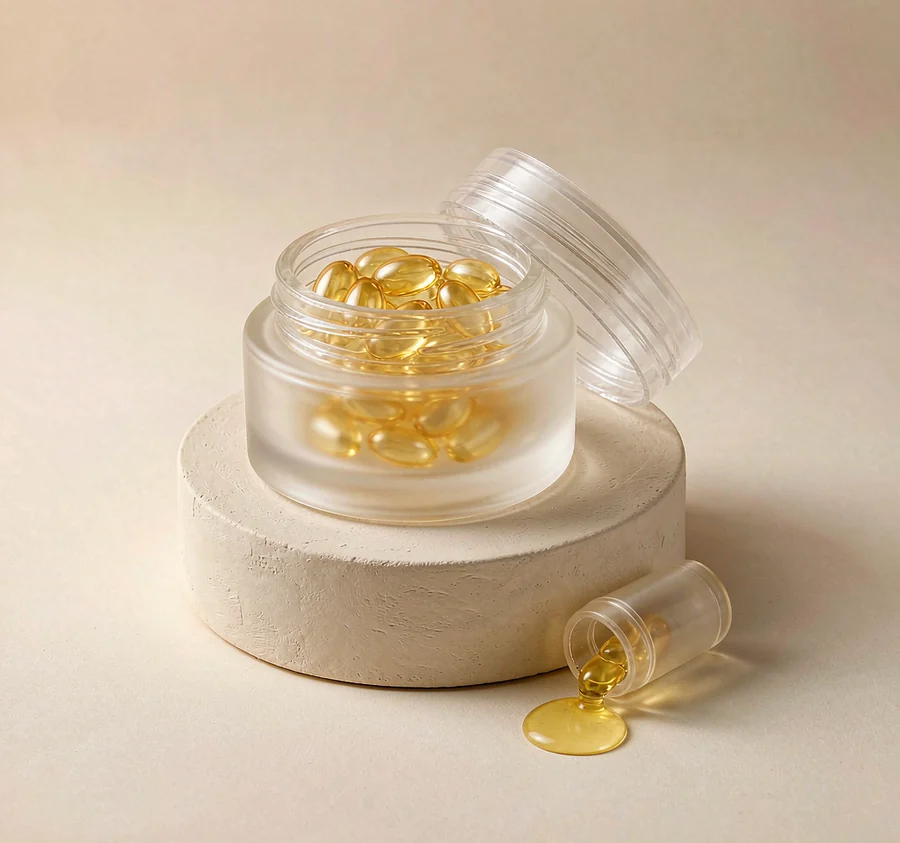
Nearly every capsule serum sold in Europe prints 36 months on the jar, and a large share of those claims rest on a template rather than a test. Shelf life is a regulated claim: it has to be supported by stability data on the actual formula in the actual primary pack, and it has to hold for the worst-case transit conditions the product will see. This article explains what a defensible 36 months looks like.
1. The three clock starts
There are three different dates in play. The manufacture date is when the batch was filled. The shelf life is the period after manufacture during which the product still meets its specification. The period after opening, printed as the open-jar symbol, is a separate declaration that assumes normal consumer use. A 36-month shelf life says nothing about the 12 or 24 months a customer may keep the jar on a shelf after opening – that is the PAO, and it needs its own justification.
2. What the protocol has to contain
A real-time study at 25 degrees Celsius with pulls at 0, 3, 6, 12, 18, 24 and 36 months, on the market-ready pack. An accelerated study at 40 degrees Celsius and 75 percent relative humidity for six months, which supports the first claim only when it agrees with the real-time trend. A cycling study between -10 and 45 degrees Celsius to simulate freight. A light-exposure study where the pack is translucent. And for anything with a biological or oxidation-sensitive active, an assay at every pull, not just a visual check.
3. Fill weight and shell integrity age too
A capsule does not only lose active. The shell loses water, the bead softens or hardens, and the fill weight drifts a few tenths of a percent as the shell equilibrates with ambient humidity. We measure bead weight at every stability pull, because a shell that has lost 4 percent of its mass sits closer to the failure point in a customer’s bathroom than on a QC bench. If a supplier’s stability summary mentions only colour and odour, the physical data is missing.
4. Where 36 months usually breaks
- Hot, humid destinations: a gelatin shell filled in a temperate plant can fail at 12 months in a tropical warehouse. Declare 24 months for those markets, or move to HPMC.
- Air freight in summer: tarmac temperatures of 50 degrees Celsius are common. A cycling test catches this; a 25 degrees Celsius study does not.
- Translucent jars: a clear jar on a sunlit retail shelf drives photo-oxidation that no dark-chamber study will show.
- Natural actives: botanical extracts with a high polyphenol load darken on their own schedule.
5. How to read a stability summary
Ask for four things: the conditions, the pull dates, the measured parameters, and the pass or fail criteria defined before the study started. A summary that says all parameters remained within specification without listing the parameters is not evidence. A summary where the criteria were written after the results is worse. Where a test failed and the formula was adjusted, the resupply must repeat the failed test, not just the visual one.
6. Shelf life and the label
Most markets require either a best-before date or a period-after-opening symbol, and the EU requires the minimum durability date when shelf life is under 30 months. A 36-month claim with a batch code and no date is acceptable in the EU only where the PAO symbol is used and durability exceeds 30 months; the batch code must still allow tracing. In the US, the label needs a lot code and the manufacturer must be able to substantiate the shelf life on request. Neither market accepts a shelf life that exists only in a brochure.
The capsule serum catalogue lists bases with their tested shelf lives. If you are comparing shells, the filling line changeover notes explain how a shell change resets the stability clock.




