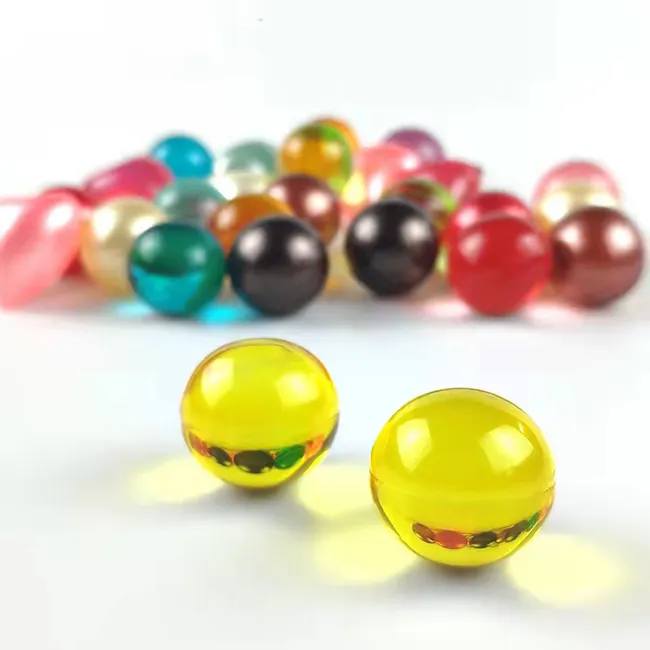
Aroma bath pearls sold into hotels and spas follow a different specification from retail pearls, and suppliers who send the same sample to both channels usually lose one of them. The hospitality buyer cares about three things retail does not: a scent that matches the rest of the amenity line, no visible residue on a white tub after housekeeping has already cleaned it, and a cost per guest night that survives a procurement review.
1. Scent families, not individual scents
A hotel amenity range is built on one or two scent families used across soap, shampoo, lotion and bath pearls. If the pearls are sourced separately, the scent will not match and the guest notices the mismatch in the bathroom, which is the room the whole stay is judged in. The practical route is to send the fragrance oil or the finished lotion to the pearl supplier and have the fill matched against it, with a side-by-side smelling test on a wet flannel rather than on paper.
2. Tub residue is the operational risk
Housekeeping turns a room in twenty minutes. A pearl that leaves an oil ring on a white tub costs more in extra cleaning than the amenity is worth. The fix is formulation, not instruction: 5 to 10 percent of a non-ionic surfactant in the fill, plus a light emulsifying ester, so the oil disperses into the water instead of floating on the surface. We test by dissolving five pearls in a white bath at 38 degrees Celsius, draining, and inspecting the tub surface after a standard wipe.
3. Presentation for a guest bathroom
- Four to six pearls in a sealed foil sachet with a printed back, placed on the tray beside the soap.
- A 60 ml jar for suites, which reads as a gift rather than an amenity.
- A sachet with a tear notch, because a guest in a bath should not need scissors.
- No loose pearls in an open dish: humidity and handling turn them into a clump within weeks.
4. The cost per guest night
A four-pearl sachet is the volume driver in this channel, and the pearl cost is small compared with the sachet, the print and the pick-pack. At 20,000 sachets the print plate cost amortises to almost nothing and the whole unit becomes a freight calculation. At 2,000 it does not, which is why small properties usually buy into a stock scent family rather than commission their own.
5. Storage and shelf life in a hotel store
Hotel stores are not climate-controlled. A gelatin pearl at 70 percent ambient humidity will soften in a sealed sachet within months, so either specify an HPMC shell or a moisture-barrier film. We recommend a 24-month shelf life for hospitality stock and a batch code that lets a procurement team rotate stock by age rather than by delivery date.
6. Sustainability questions a buyer will ask
Three are standard: is the shell animal-derived, is the sachet recyclable, and is the fragrance free of the EU-declared allergens above threshold. HPMC shells answer the first; a mono-material PE or paper sachet answers the second; a low-allergen fragrance concentrate with a full IFRA certificate answers the third. Having those three documents ready shortens procurement more than any price concession.
7. Order profile
Four-pearl sachet, 4 mm pearl, MOQ 2,000 sachets, 3 to 4 weeks after artwork. A 60 ml suite jar starts at 500 jars. Scent matching against a supplied lotion adds one week. See the aroma bath pearl range and the pearl manufacturing notes for the fill and dissolution specification behind these numbers.




