Key takeaways
- The follicle is the target; anything that stays on the hair shaft is a conditioning product, not a growth product.
- Rosemary, caffeine and peptides have plausible mechanisms but modest evidence — write claims to match.
- Leave-on formats (ampoule, roll-on, capsule) beat shampoo for any scalp claim.
- Contact time, low residue and a non-irritating vehicle decide whether the active does anything.
There is no cosmetic that regrows hair, and any supplier who says otherwise is selling you a regulatory problem. What a scalp product can do is reduce the conditions that make thinning look worse — irritation, oiliness, flaking, and the breakage that comes from a rough routine — and support an environment where the follicle is less stressed. Everything in the category has to be written on that foundation.
The surface is different, so the formula is different
Scalp skin is thicker and carries more sebaceous glands than the face. Hair covers it, so application is uneven and evaporation is slower. Two consequences:
- Spreading is the first problem. A watery serum runs off; a slightly thickened one can be parted along the scalp line with a nozzle or a rollerball.
- Residue is the second. Anything that leaves a film makes hair look greasy within hours, which is why scalp products are usually low-oil or water-based despite the lipid-rich target.
The three actives worth formulating with
Rosemary leaf extract and oil. The most requested botanical in the category, on the strength of one small comparative trial against minoxidil. The mechanism is usually attributed to improved microcirculation. Plausible, not proven — a “supports scalp comfort and appearance” claim is defensible, a growth claim is not.
Caffeine. Well studied in vitro for its effect on hair follicle signalling, poorly studied in vivo. It penetrates the follicle readily, which is why it appears in both shampoos and leave-ons — though in a shampoo the contact time is seconds.
Peptides. Small enough to reach the follicle, and the most honest of the three to formulate with, because the claim can be limited to appearance and density of the hair shaft rather than growth.
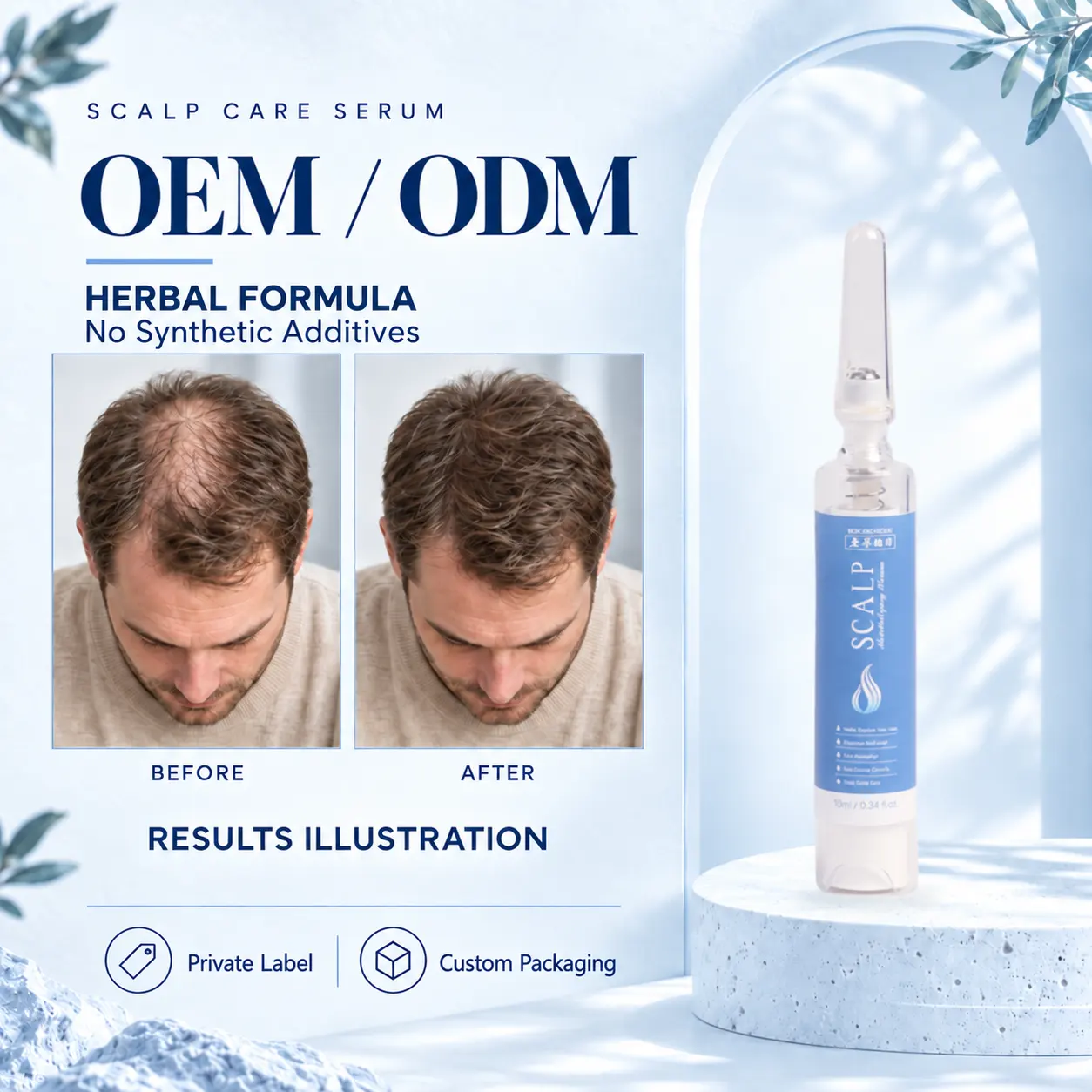
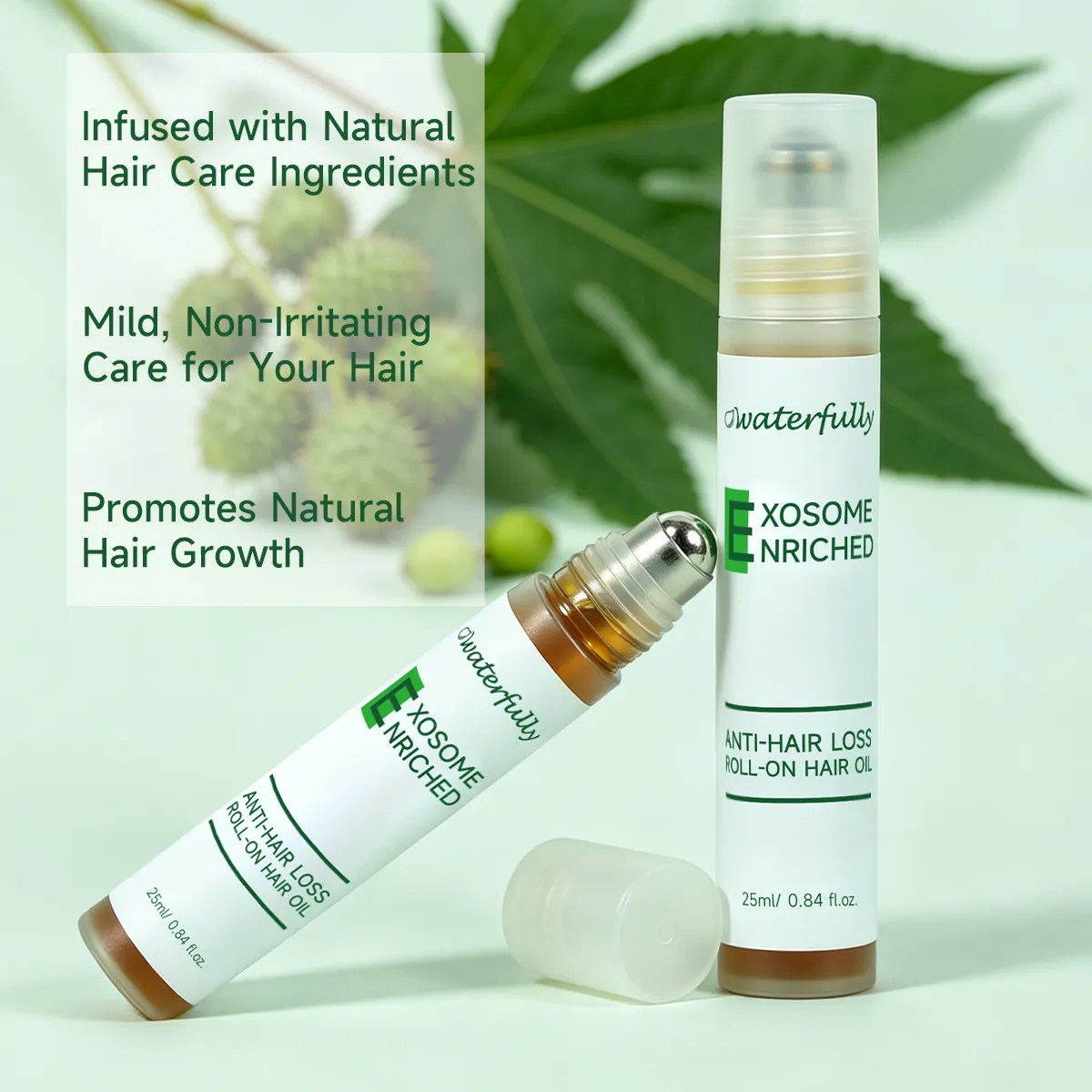
Our herbal no-synthetic-additive scalp serum is built on the botanical route, while the peptide and rosemary roll-on is the oil-based alternative for a drier scalp.
Which format delivers
| Format | Contact time | Realistic role |
|---|---|---|
| Shampoo | Seconds | Cleansing and scalp feel; no meaningful active delivery |
| 10 ml ampoule | Hours, single use | Highest dose per application; the format that suits a course |
| Roll-on | Hours, metered | Precise application along a parting, less waste |
| Capsule | Hours, single dose | Oil-based treatment; protects the active from air |
| Spray | Hours, uneven | Coverage across a large area, harder to dose |
The hair essential oil capsule format is the one to pick when the active is an oil and the customer wants no dropper. A 10 ml ampoule is the one to pick when the brief is a four-week course, because the dose per application can be declared.
Production notes
Botanical extracts. Standardisation is the variable. Two suppliers can sell “rosemary extract” at different rosmarinic acid contents, and the label cannot tell the difference — the COA can. We specify the marker and assay it on receipt.
Water-based scalp serums need a preservation system and a challenge test like any aqueous product, plus a check that the preservative does not sting on a scalp that is already irritated.
Oil-based roll-ons need viscosity that lets a rollerball turn without flooding, and a carrier oil that does not oxidise — the reason we cap the polyunsaturated fraction and add tocopherol.
Filling. A 10 ml ampoule is filled and sealed on a glass line; a 25 ml roll-on on a bottle line with a ball-and-cap assembly that has to pass a leak test. Both are 25 to 35 days from artwork, with stock-base samples in seven days.
Testing a scalp product honestly
- Assay the botanical marker or the peptide in the bulk, and again at three months.
- Check the preservative challenge where the formula is aqueous.
- Run a 30-subject patch test on the scalp, not the forearm — the two behave differently.
- Measure residue: a weighed hair swatch test tells you whether the product leaves a film.
- Stability at 40 °C, watching for botanical colour drift and oil oxidation (peroxide value).
None of that proves regrowth. It proves the product is safe, stable, and contains what the label says — which is the part a factory can actually stand behind.
For the capsule format itself, see shell composition and fill compatibility; the hair care category carries the shampoo, mask and serum variants of the same story.
Send the target scalp condition and format to the inquiry form; the actives follow from the format, not the reverse.
Reference: EU Regulation 1223/2009; internal hair care line and stability data

