Key takeaways
- A lamellar gel network is built from emulsifier bilayers swollen with water, not polymer.
- Cetearyl alcohol at 3 to 8 percent with a matching emulsifier is the usual backbone.
- Emulsifier to fatty alcohol ratios of 1:2 to 1:4 normally give the firmest structure.
- Cooling at 1 to 2 C per minute between 60 and 40 C decides whether the network forms.
- Water layering, graininess and viscosity drift by week four are classic failure signs.
Most good creams are structured by something other than a thickener. A fatty alcohol and an emulsifier, cooled slowly through a narrow temperature band, build stacked bilayers that swell with water and give the emulsion a yield point. Understand that step and texture stops being a matter of luck.
1. The structure in plain terms
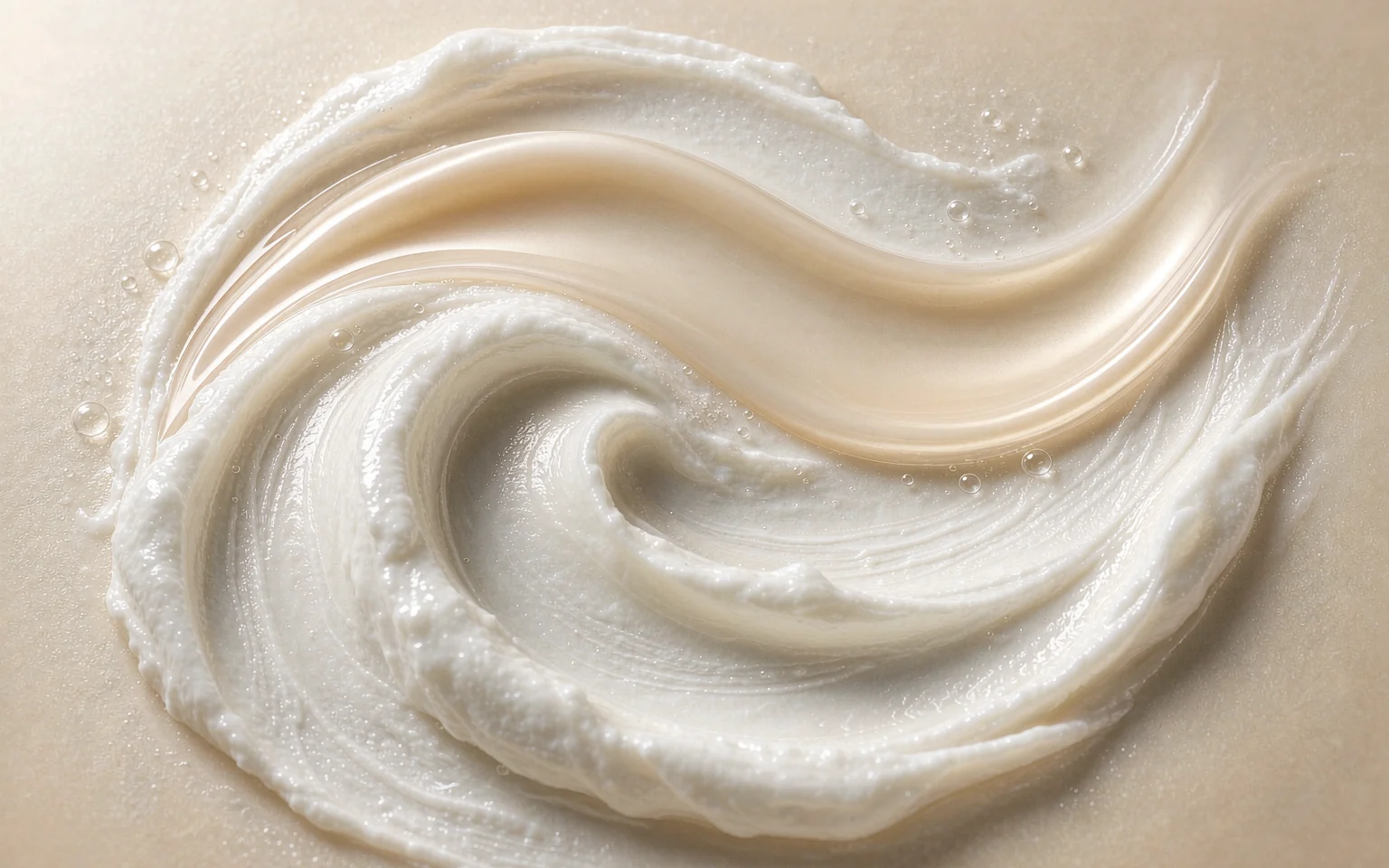
An emulsifier with a long fatty tail and a fatty alcohol such as cetearyl alcohol both prefer to sit in an oil-water interface. When they are cooled together in water they stack into bilayers, and those bilayers swell with water to form a gel phase. The result is a three-dimensional network that traps oil droplets and resists flow at rest.
2. The fatty alcohol pair
Cetearyl alcohol, a blend of C16 and C18 alcohols, is the workhorse because its chain length matches common emulsifiers. Typical use levels run 3 to 8 percent. Below 3 percent the network is too thin to hold a jar shape; above 8 percent the cream rubs in like soap and leaves a waxy film on skin.
3. Ratios that usually work
The ratio between emulsifier and fatty alcohol matters more than the total. Values between 1:2 and 1:4 normally give a firm, glossy cream, for example 2 percent glyceryl stearate with 5 percent cetearyl alcohol. Pushing toward 1:1 raises the emulsifier load and can leave the surface tacky rather than smooth.
4. The processing window
The network forms on cooling, not on homogenisation. Emulsify at 70 to 80 C, then cool at 1 to 2 C per minute with low shear between 60 and 40 C. Fast cooling through that band, or high shear while the bilayers are forming, gives a grainy or semi-translucent cream that never recovers on storage.
5. What it does for viscosity
A well-formed network raises yield value sharply, which is why a cream can sit at 20,000 to 40,000 mPa.s with no carbomer at all. The viscosity is also more shear-thinning than a polymer gel, so the product spreads easily and then stays where it is placed. That combination is hard to copy with a thickener alone.
6. Effect on actives and electrolytes
Bilayers can slow the release of oil-soluble actives and can trap electrolytes in the water phase, which matters for salt-heavy formulas. A high electrolyte load, from a urea or an AHA system, typically disrupts the network and drops viscosity within weeks. Check compatibility before choosing this structure for an acid product.
7. Signs the network failed
Four symptoms repeat: a watery layer at the surface after two weeks, visible graininess under a spread test, viscosity that falls 20 percent or more by week four, and a waxy rather than cushiony rub-in. Each points back to the cooling profile or to an emulsifier that does not co-crystallise with the fatty alcohol.
8. How to measure it
Oscillatory rheology is the direct route: a storage modulus well above the loss modulus across the linear region indicates a gel network. Under polarised light microscopy the same structure appears as Maltese crosses. Both are cheap to run on a sample and both show a difference that a spread test only hints at. A single point measurement at one shear rate tells you far less than a frequency sweep across the linear region.
9. Where it stops working
Above roughly 25 percent oil the bilayers are too diluted to build a continuous network, and a polymer or a wax is needed. Very low pH with an anionic emulsifier, high salt, and large amounts of glycols all weaken it. In those cases the formula needs a different structuring route rather than more fatty alcohol.
10. Where it fits
Emulsion formats and pack options are listed in the creams category, related formulation notes sit in the encyclopedia, and process notes appear in news.
Reference: Formulation development notes, 2025