Key takeaways
- Effervescence comes from bicarbonate and citric acid at a 1:0.8 ratio.
- Compression pressure above roughly 15 kN slows dissolution and leaves residue.
- Humidity during storage is the main cause of premature reaction in the pack.
A bath pearl is a small compressed sphere of bicarbonate, citric acid, a binder and colour that reacts with water to produce carbon dioxide. The chemistry is simple; the manufacturing is not. A pearl that dissolves in ninety seconds with a clear colour is a pearl where the ratio, the compression and the humidity control all worked.
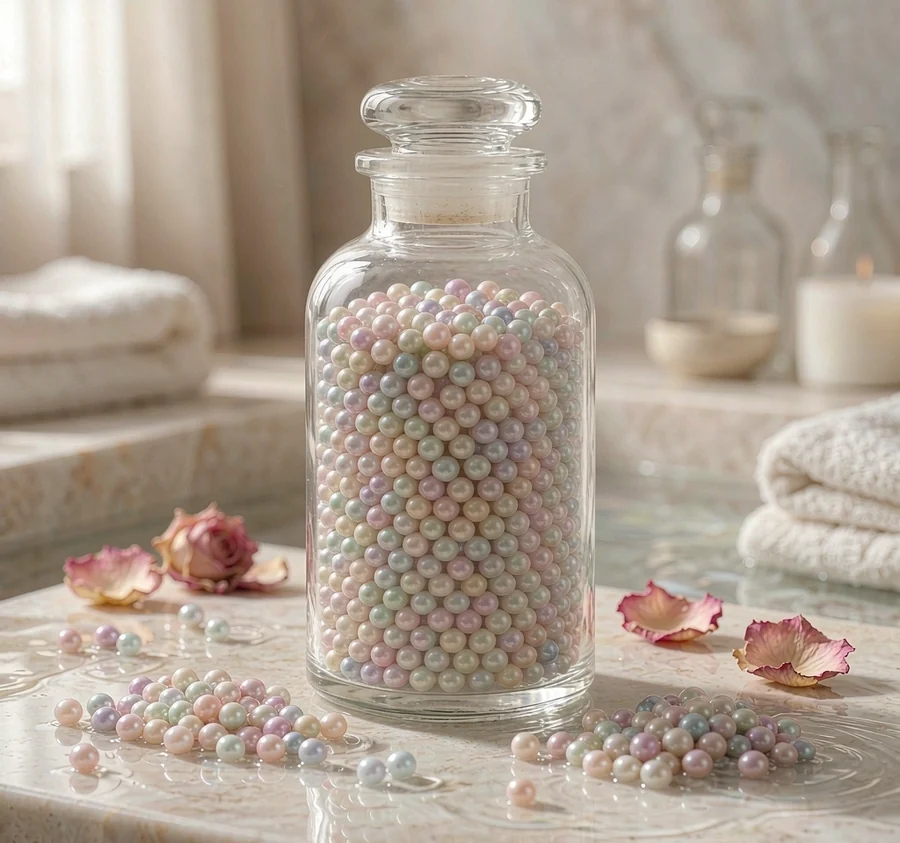
The category has moved from large bath bombs to smaller pearls and pearl sets because the pearl dissolves faster, ships cheaper and can be sold in a jar as a visual product. The smaller the pearl, the less forgiving the compression: there is less material to buffer a hard centre.
1. The effervescent ratio
Bicarbonate and citric acid at roughly 1:0.8 by weight give a complete reaction with a slight excess of bicarbonate, which keeps the bath pH mild. More acid gives a sharper fizz and a lower pH that can irritate; more bicarbonate leaves a slippery residue. The ratio is the first specification and should be recorded per batch.
2. Binder and hardness
A binder — typically a small amount of PEG, a starch or a pressing aid — holds the pearl together. Too little and the pearl crumbles in the jar; too much and it dissolves slowly and leaves a film. Water is used as a transient binder during granulation and must be controlled to within a narrow range, because residual moisture starts the reaction in storage.
3. Compression
Press force sets the porosity, and porosity sets the dissolution rate. Above roughly 15 kN the pearl becomes dense and slow; below 8 kN it is fragile. The window is narrow and depends on the granule size, so a change of powder supplier can move the window without warning. Record the force and the pearl weight together.
4. Colour and pigments
Water-soluble colours give a clear tint; lakes and micas give a shimmer but can leave a ring on the tub. Pigment loading above 0.5 percent usually leaves residue, and the residue is what customers photograph in a complaint. Test dissolution in a white basin at 38 degrees and photograph the result before approval.
5. Fragrance and oils
Fragrance at 1 to 3 percent is normal, but oils soften the pearl and slow the reaction. A pearl with 3 percent fragrance oil needs more binder and a higher press force, which pushes dissolution time up. Citrus fragrances oxidise and can discolour a white pearl within months, so a stable fragrance or a coloured pearl is the safer choice.
6. Humidity in the pack
A pearl starts reacting as soon as it absorbs moisture from the air. A jar with a desiccant sachet and an induction seal holds for twelve months; a paper box does not. Test at 30 degrees and 75 percent relative humidity for four weeks and check for swelling, and store the finished goods in a dehumidified area rather than next to the filling line.
7. Sets and gift packs
Pearl sets multiply the appeal and the logistics: mixed colours, mixed fragrances and a jar that shows the product. Mixing lots in one jar means the stability of the set is the stability of the weakest pearl, so all variants should share a base formula and differ only in colour and fragrance.
8. Where it fits
Bath pearls sit in the bath pearl range; the packaging side continues in the mono-material entry.
Reference: Bath product development and dissolution trials, 2025

