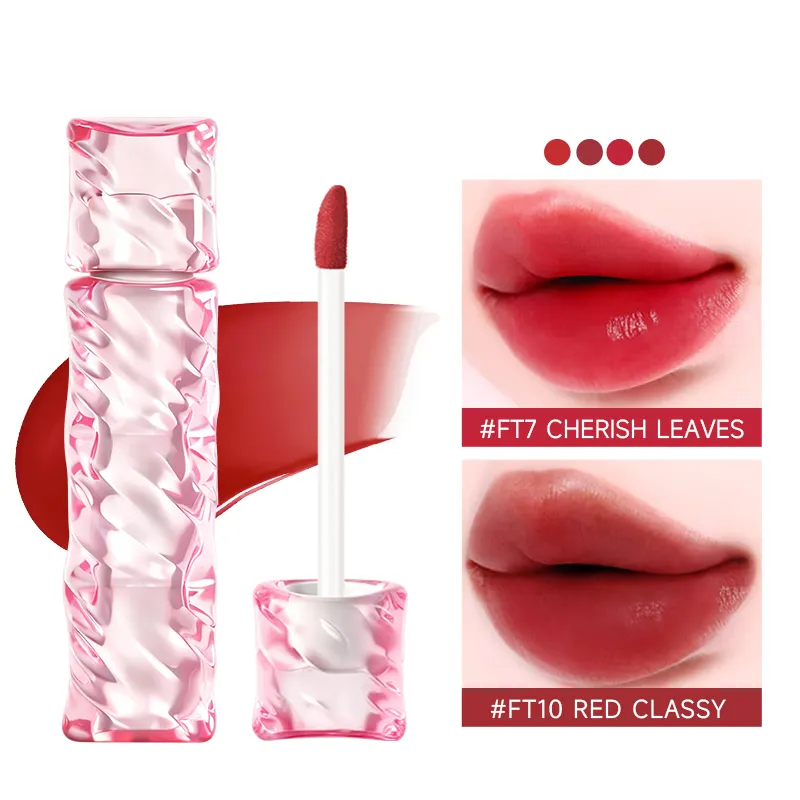
Key takeaways
- Water stains use acid dyes that bind to keratin and survive eating and drinking.
- Oil tints rely on pigment dispersed in an oil base and transfer onto everything.
- Matte fluids need a volatile carrier plus a film former to set without drying out.
A lip tint is defined less by its colour than by how it leaves the lip. Three chemistries dominate the category — water-based stains, oil-based tints and matte fluids — and each produces a different wear curve, a different comfort profile and a different set of labelling obligations. The formula follows from the wear behaviour the brief asks for, not the other way round.
The practical difference shows up within an hour of application. A water stain looks faint at once and deepens over twenty minutes as the dye penetrates; an oil tint looks vivid immediately and is gone after one meal; a matte fluid sets in ninety seconds and then holds until it is deliberately removed. Brands that mix these promises in one product usually get a formula that does none of them well.
1. Water stains and dye chemistry
A water stain is an aqueous gel with an acid dye — commonly a fluorescein derivative or a food-grade colour — at 0.1 to 0.5 percent, thickened with a carbomer or a cellulose gum. The dye binds to the keratin of the lip surface, which is why the colour survives eating and drinking and why it also stains the skin around the mouth if applied carelessly. pH matters: below 4 the dye penetrates faster and the stain is deeper.
2. Oil tints
An oil tint disperses pigment or a dye in a light oil base — often a combination of caprylic/capric triglyceride and a small amount of wax for body. Comfort is high, shine is high, and transfer is total: the colour moves onto cups, masks and collars. The category sells on comfort and gloss rather than longevity, and the pack copy should not promise wear time it cannot deliver.
3. Matte fluids
A matte fluid uses a volatile carrier such as isododecane, a film former and dispersed pigment. The carrier evaporates in about ninety seconds, leaving a flexible film with the pigment locked in. Transfer resistance is good but not absolute, and the film fails at the inner lip line where saliva constantly attacks it. Pigment loading of 15 to 25 percent is normal for full coverage.
4. Comfort and the drying question
All three formats can dry the lip, and the mechanism differs. Water stains draw moisture as the water evaporates; matte fluids leave a film that restricts the lip’s natural moisture loss less than it feels; oil tints are the most comfortable and the least durable. A humectant such as glycerin at low dose and a small amount of oil improve comfort without destroying the format.
5. Application and precision
A water stain is applied with a doe-foot and must be spread quickly, because once the dye sets the edge is fixed. A matte fluid needs a precise applicator because the film sets where it is placed. An oil tint forgives imprecision. The applicator, therefore, is part of the product specification rather than a packaging afterthought.
6. Colour measurement and batch consistency
Stains look different on every lip tone, which makes colour matching difficult across a batch. Measure the neat liquid on a spectrophotometer and set a tolerance of 1.5 ΔE; then check the stained appearance on three skin tones. A batch that passes on the instrument and fails on the lip is usually a pH drift rather than a pigment error.
7. Stability and packaging
Water stains need a preserved system and a pH that does not drift; a stain whose pH rises above 5 fades within weeks. Matte fluids are anhydrous and stable but volatile, so the pack must limit evaporation — a tight cap and a liner, tested by weighing the filled unit over twelve weeks. An oil tint is the most stable of the three and the least sensitive to pack choice.
8. Where it fits
Tints sit in the liquid lip tint range; the film-former question is shared with the film formers entry.
Reference: Lip colour development records and wear panel results, 2025

