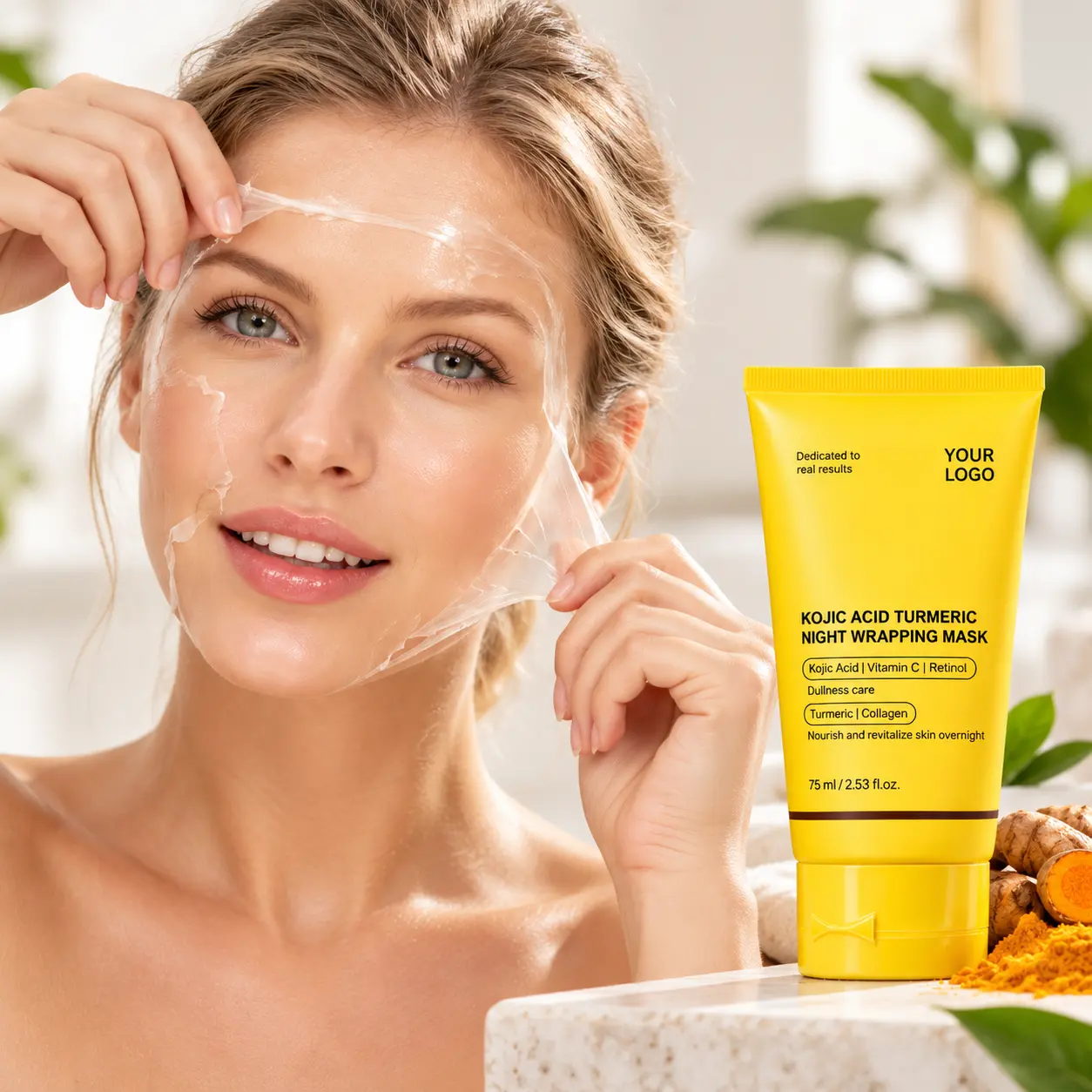
Peel-Off Mask OEM briefs almost always contain the same two requirements: it must peel in one piece, and it must not hurt. Those two are in direct opposition. A film strong enough to lift in a single sheet is also strong enough to grip vellus hair and the top of the stratum corneum, which is where the pain comes from. The good products find a window between them, and the formulation work is mostly in the plasticiser and the film thickness.
1. Film formers and what each gives
Polyvinyl alcohol (PVA) is the workhorse: it forms a strong, continuous, water-resistant film at 8 to 15 percent solids. Polyvinylpyrrolidone (PVP) gives a softer, more water-sensitive film and is often blended in to reduce peel force. Pullulan and other polysaccharide films feel silkier and peel more gently at lower solids, but they cost more and dry more slowly. A typical retail peel mask is a PVA-dominated blend with 10 to 20 percent of a softer polymer.
2. Plasticisers decide the pain
Glycerin at 3 to 8 percent softens the film and lowers peel force. Above 10 percent the film becomes tacky and never fully sets, which reads as a product that will not peel at all. Propylene glycol and a small amount of a PEG ester do the same job with a lighter feel. The measurable target is a peel force of roughly 0.5 to 1.5 newtons per 25 mm width on a standardised substrate – strong enough to lift, low enough not to sting.
3. Dry time and film thickness
Consumers judge a peel mask by how long it takes to set. At 20 to 25 degrees Celsius and 50 percent humidity, a 1 mm wet film of a 12 percent PVA solution sets in 15 to 20 minutes. Thicker application doubles the time and increases peel force, so the instruction should specify a thin, even layer – and the copy should say 15 minutes, not 10, or customers will peel early and blame the product for being sticky.
4. Active loading and compatibility
Peel masks are a poor vehicle for actives that need to penetrate, because the film forms a barrier within minutes. What they do well is mechanical removal of surface flakes and sebum plus a short contact with humectants. Clay at 3 to 8 percent gives a mattifying and mildly absorbent effect without breaking the film; charcoal is a colour story more than a chemistry one. High electrolyte loads – salts, strong acid buffers – destabilise PVA and should be avoided.
5. Packaging
A tube is the right pack: the film former is water-sensitive and a jar lets the surface skin over. A 50 to 100 ml tube with a flip cap and a wide nozzle works with the viscosity, and a sachet is viable for trial sizes if the fill temperature is controlled to avoid sealing through the product. Avoid metal tubes with an incompatible internal lacquer, since acidic formulas can corrode the lining over a two-year shelf life.
6. Testing
- Peel force on a standardised substrate, three films per batch.
- Dry time at 20 and 28 degrees Celsius, since summer use changes the experience.
- Film continuity: a film that breaks at the jaw is a defect, not a user error.
- Skin tolerance on 30 subjects, because mechanical removal is itself an insult.
- Stability at 40 degrees Celsius, watching for syneresis and viscosity drift.
7. Commercial profile
Stock PVA base, 60 ml tube, MOQ 1,000 units, 25 to 35 days. A soft-peel variant for sensitive skin adds two weeks of sampling. See the peel-off mask range for stocked bases, and the jelly mask notes if you are comparing rinse-off textures.




