Perfume capsules OEM is a small, fast-growing niche with a very specific technical constraint: the standard fragrance carrier is ethanol, and ethanol dissolves or softens most capsule shells. Every successful alcohol-free fragrance bead on the market has solved this by changing the carrier, not by hoping the shell holds. Here is how the format is actually built, and what it can and cannot claim.
1. What the format is good for
A 0.3 to 0.5 ml bead of fragrance oil carried in a silicone or ester base, packed thirty to sixty to a jar. It suits trial and travel sizes, amenity programmes, gift-with-purchase, and subscription boxes. It does not suit a fine fragrance launch that needs a top-note progression over six hours: a single dose applied once gives a short, linear wear of two to four hours, and the sensory expectation of a perfume bottle is different.
2. The carrier question comes first
Ethanol at 60 to 80 percent, the backbone of an eau de parfum, is incompatible with a gelatin or HPMC shell at any useful concentration. The workable alternatives are a volatile silicone such as cyclopentasiloxane, a light ester such as isopropyl myristate, or a glycol ether blend. Silicone carriers give the best shell compatibility and the driest skin feel; ester carriers give better projection and a slightly oilier residue. Most amenity and travel beads use a silicone-dominant carrier at 25 to 40 percent fragrance concentrate.
3. Perfume oil selection
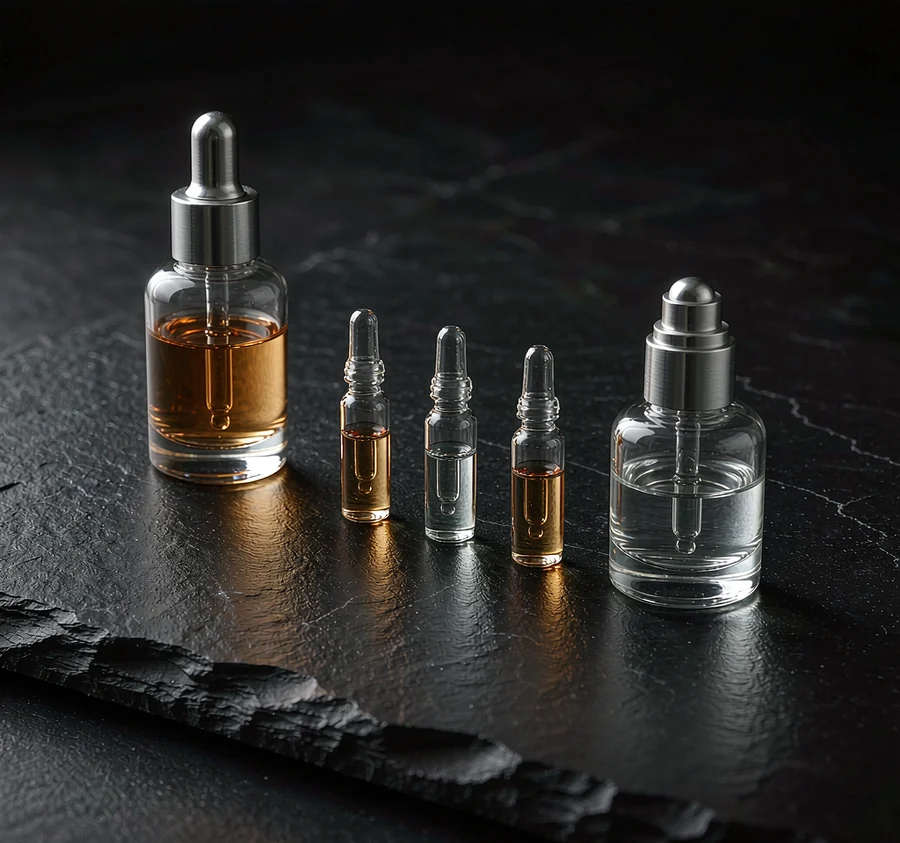
Because the carrier is not alcohol, the fragrance itself is supplied as a perfume oil rather than a compounded eau de parfum. Ask for a concentrate that has been tested for colour stability in the carrier, not just in ethanol. Vanilla, citrus and some floral absolutes discolour in silicone carriers within months, and a bead that turns brown in a clear jar is unsellable. Request a three-month colour hold at 40 degrees Celsius before you commit to a 5,000-piece run.
4. Line parameters
Smaller beads need the rotary die running slower than for a facial serum: 0.4 ml fills run at roughly 30,000 beads an hour with a plus or minus 4 percent weight tolerance. Shell gauge is typically 0.8 to 0.9 mm to survive the higher oil load. Drying runs 20 to 24 hours at 22 degrees Celsius, longer than a standard serum bead, because the shell must lose its water before the oil can migrate into it.
5. Leak risk and how it is managed
Oil-filled beads fail at the seam, not the wall. The three controls that matter: a seam inspection under polarised light, a 24-hour inverted hold at 40 degrees Celsius on a sample, and a compression test to a defined force. If a supplier cannot describe their seam check, the format is being run on a machine set up for water-based fills, and the failure will show up in a customer’s handbag rather than in their QC room.
6. Claims and labelling
Fragrance beads are cosmetic products in every major market and need the full ingredient list, including the allergen declaration required in the EU where any of the 26 labelled fragrance allergens exceeds the threshold. Calling the product a perfume is defensible; calling it an eau de parfum is not, because the alcohol and concentration definitions do not apply. If you intend a skin-sensitisation claim or a therapeutic aromatherapy claim, stop and check the market rules first – aromatherapy claims are regulated as medicinal in several countries.
7. Order profile
Stock silicone carrier, 0.4 ml fill, 30 beads per jar, MOQ from 500 pieces, 25 to 35 days. A custom fragrance oil adds two to three weeks for sampling and a colour hold, and a custom jar is the usual schedule risk. The perfume capsule range shows the current carriers and bead sizes; the capsule line guide explains the die and drying fundamentals that apply here too.