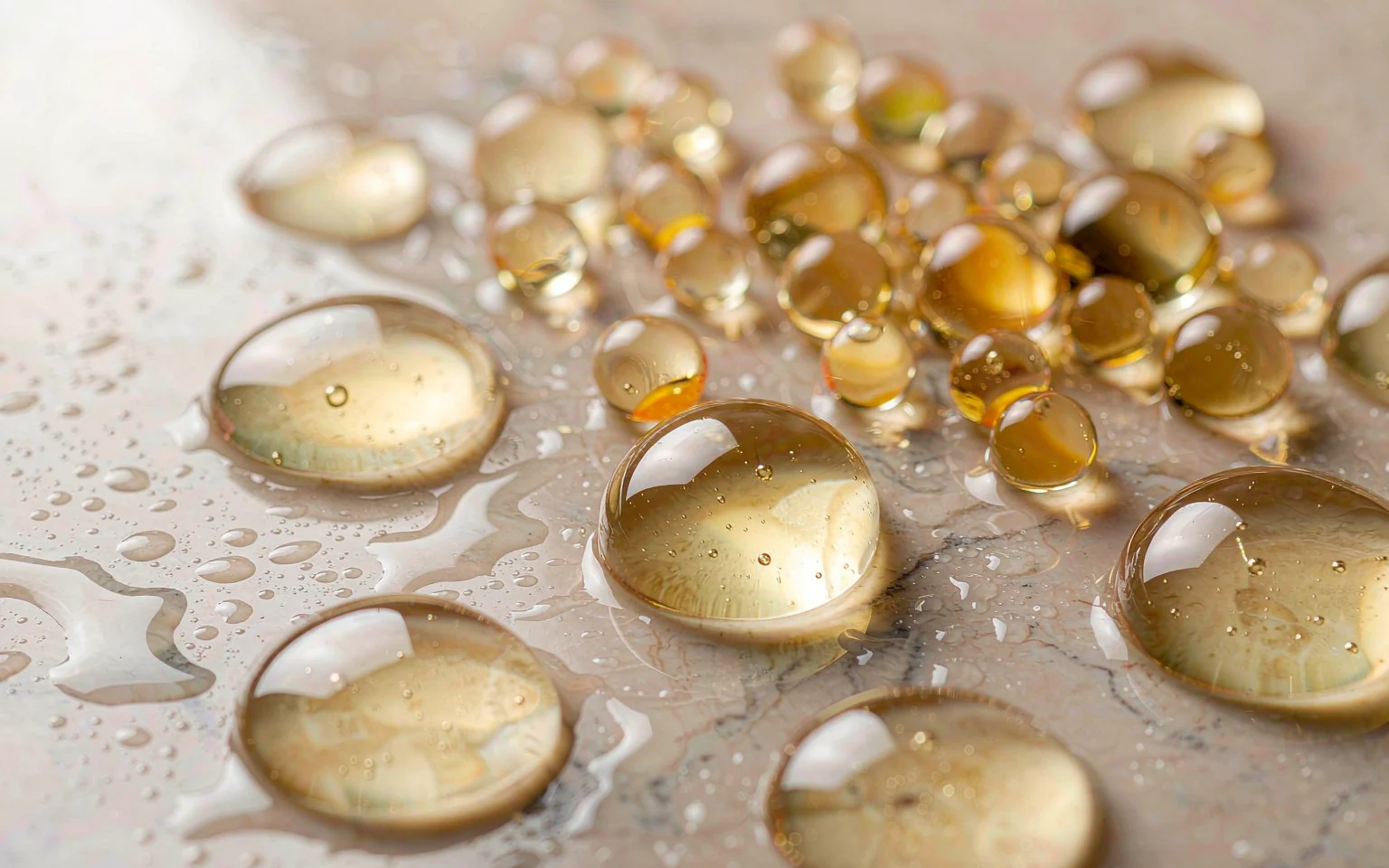
Capsule serum manufacturing compresses a skincare formula into a single 0.3 to 1.0 ml bead that a customer twists open once and throws away. It looks simple on a shelf and is unforgiving on a line: the fill weight has to hold within a few percent, the shell has to survive three years of freight, and the seal has to open cleanly without splitting the bead down the middle. This article walks through what happens between the bulk tank and the jar, in the order it happens.
1. What the format actually is
A capsule serum is a low-viscosity liquid or a light emulsion enclosed in a soft shell – gelatin, HPMC (a vegan cellulose shell), or a starch blend – formed, filled and sealed in one rotary-die operation. The common commercial unit is a 0.5 ml bead, thirty to ninety beads to a jar, 15 to 45 ml net content. There is no air in the bead, which matters: oxidation-sensitive actives such as retinol and ascorbic acid behave very differently in a capsule than in a dropper bottle where the headspace is renewed every time the cap opens.
2. Fill weight is the first quality gate
A rotary die runs at roughly 42,000 beads an hour on a mid-size unit. The specification we work to is 0.5 ml with a plus or minus 3 percent tolerance, which means every bead weighs between 0.485 and 0.515 g. That band is not cosmetic. If the low tail drifts to 0.45 g the customer gets 27 effective doses instead of 30, and the complaint lands on the brand, not the filler. We weigh a 30-bead sample every 30 minutes and chart it against the control limits rather than waiting for the end-of-batch check.
3. Shell material decides your stability file
Gelatin shells are the cheapest and the most forgiving on sealing, but they are animal-derived and they soften in hot, humid climates. HPMC shells are vegan and hold shape better at 40 degrees Celsius, but they need a tighter drying tunnel and they seal at a narrower temperature window. A starch blend sits between the two on cost and behaves well with high-water formulas. Whichever you pick, the choice changes the water-loss rate of the fill by a factor of two or three, so it must be locked before the stability protocol is written – not after.
4. How the line runs, step by step
- Bulk compounding in a jacketed tank, oil phase at 75 to 80 degrees Celsius, water phase at the same temperature, then homogenised and cooled to 25 degrees before filling. Volatile actives go in after the cool-down.
- Shell film casting on a chilled drum, gauged to 0.7 to 0.9 mm, then fed to the die.
- Form, fill and seal in one rotation, with the seam inspected by a pressure roller.
- Drying tunnel at 22 to 25 degrees Celsius and 25 to 35 percent relative humidity for 16 to 20 hours.
- Polishing in a tumbling drum with a food-grade wax, then a visual and dimensional sort.
- 100 percent vision inspection on shape, colour, and seam integrity, followed by a vacuum leak test on a sample.
5. Inspection, yield and the numbers that leak money
A healthy line runs 97 to 99 percent good beads; a poorly tuned die runs 88 percent and nobody notices because the scrap is weighed as bulk. Ask a supplier for their scrap rate and their rework policy in writing. A two-point gap on yield is roughly the difference between a 0.11 USD and a 0.14 USD bead on a 0.5 ml fill, which compounds across a million units.
6. MOQ, tooling and lead time
On a stock shell and a stock formula, MOQ from 500 pieces is realistic and 25 to 35 days after sample approval is a normal schedule. A custom shell colour or a custom die shape adds three to four weeks of tooling, and a new formula adds a four-week stability pre-screen before the first commercial run. Brands that plan a launch for a fixed trade fair date should work backwards from the fill date, not from the artwork approval date.
7. What to send a supplier for a useful quote
- Target fill volume and beads per jar, plus net content.
- Active ingredients, target percentages, and any claim you intend to print.
- Shell preference (gelatin or vegan) and the markets you will sell into.
- Packaging: jar, cap, and whether you need a carton.
- First order quantity and annual forecast.
The full format range, including anti-aging, whitening and barrier-repair bases, sits in our capsule serum and essence catalogue. If you are still choosing between a capsule and a bottle, the changeover notes from our filling line explain what a format switch costs in tooling and downtime.