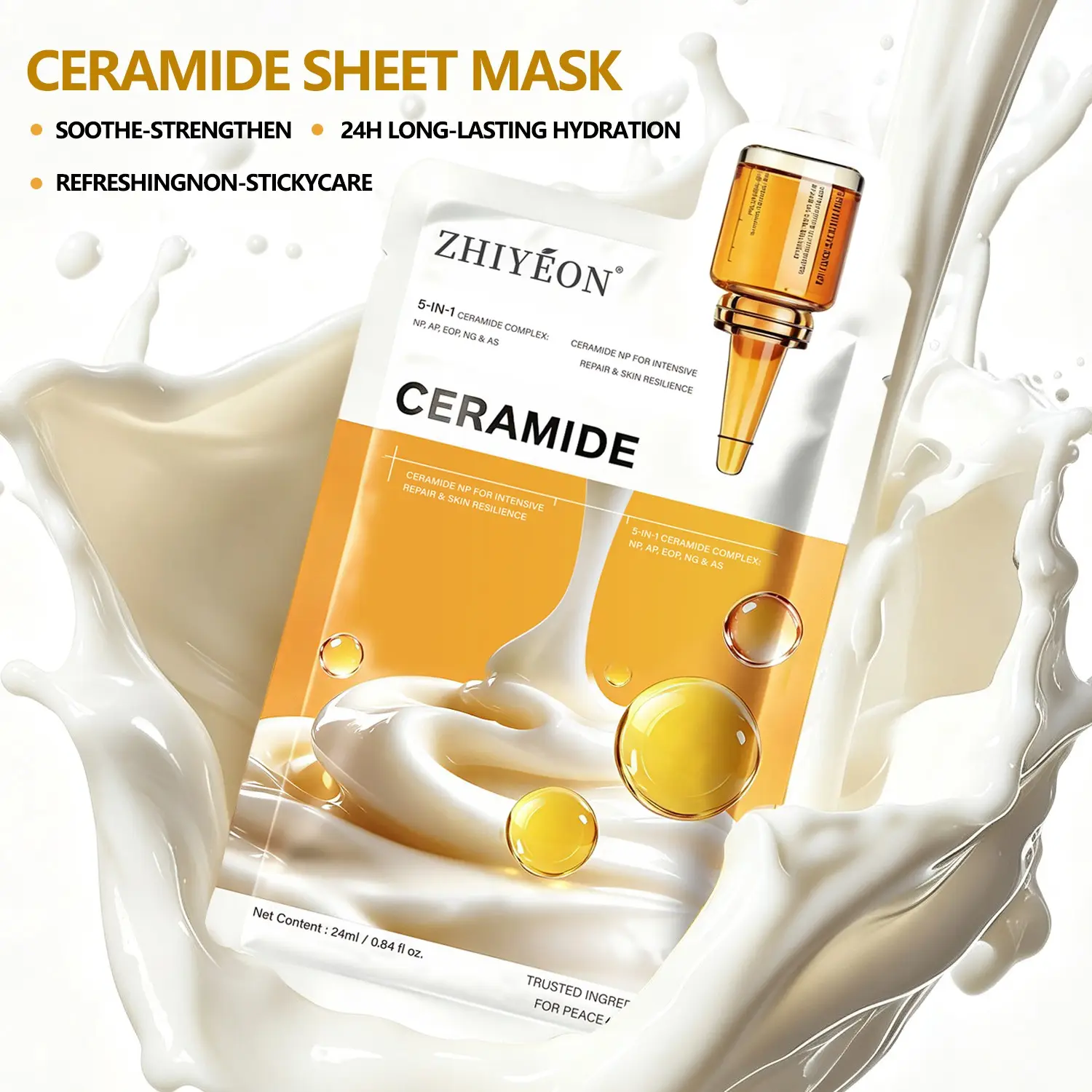
People judge a sheet mask by how wet it feels. The formulation decides whether that wetness is a serum or salt water. A 24 ml mask carries more liquid than most face serums sold in a 30 ml bottle, and that liquid has to be stable, preserved, and worth putting on skin. Our ceramide sheet mask is a good case: the barrier claim on the pack is a claim about the essence, not about the cloth.
Why ceramides are the right active for a mask
Ceramides are the lipids that fill the space between corneocytes; roughly half the lipid mass of a healthy stratum corneum is ceramide. Skin with a compromised barrier has less of it, and that shows as tightness, redness and increased water loss.
Three formulation details decide whether a ceramide mask does anything:
- The ratio. Ceramides only rebuild a barrier when paired with cholesterol and fatty acids, conventionally around 1:1:3 by weight. A mask with ceramide alone is a humectant mask with a lipid claim.
- Delivery. Ceramides are oil-soluble and poorly water-soluble. In a 24 ml aqueous essence they need a solubiliser or a liposomal carrier, and the choice affects both clarity and how much reaches the skin.
- Occlusion. The wet sheet itself reduces water loss for 15 minutes, which is what makes the immediate plumped look convincing. That effect belongs to the format, not the ceramide.
Our version pairs the ceramide complex with centella asiatica, glycerin and aloe — a soothing and humectant supporting cast. Panthenol and allantoin do the same job in other SKUs, and the choice is usually about the market rather than the science.
The essence is a bulk batch, not a topping
At 24 ml per mask, a 3,000-piece run needs 72 kg of essence. That is a full production batch with its own pH target, its own preservation system and its own stability file. It is also why adding a mask to a range costs more than buyers expect.
- Water phase — humectants, chelator, pH buffer, heated and mixed.
- Ceramide dispersion — the lipid phase is solubilised or liposomally prepared, then added below 45 °C so the carrier does not break.
- Preservative and pH — set to the spec, then a retention sample is pulled and assayed before any cloth is wet.
- Challenge test — the essence is challenged to ISO 11930 before the pouch is qualified, because a mask pouch is a wet, single-use environment with no preservative margin for error.
Saturation, folding and sealing
Three mechanical steps decide whether the customer’s mask is evenly wet:
Saturation. The cloth passes through an essence bath or is dosed onto the web. Over-saturation wastes essence and causes pouch overflow; under-saturation leaves dry corners that read as a quality failure before the customer reads the label.
Folding. Fold geometry has to match the pouch and the die cut, or the mask arrives creased in the wrong place and does not fit a face.
Sealing. Aluminium laminate, heat-sealed on four sides, with a headspace that leaves room for the mask to move. A seal that is 0.5 mm narrow passes a visual check and leaks in a carton.
The batch release checks
| Check | Specification | What it protects |
|---|---|---|
| Essence weight per pouch | 24 g ± 3% | The declared net and the customer’s first impression |
| Seal strength | Burst and dye penetration | No drying out over 36 months |
| Essence assay | Ceramide and centella within spec | The claim on the front of the pack |
| Micro and challenge | ISO 17516 / ISO 11930 | Safety in a wet single-use format |
| Stability | 3 months at 40 °C / 75% RH, real time in parallel | Cloth yellowing, essence separation, seal creep |
| Patch test | 30 subjects, 24 h occlusive | Irritation from the preservative, not the active |
What a brand chooses, and what it costs in time
Cloth material is the biggest visible variable: cotton for a soft hand, tencel for a tighter, more even sheet, cupro for a silky drape. The essence is the biggest invisible one, and it is where customization is actually worth paying for. Stock ceramide base samples come in seven days; a custom essence with a proprietary active set takes ten to fifteen days plus a challenge test before the pouch can be released.
Minimum 3,000 pieces across the mask lines, 25 to 35 days from artwork sign-off, batch COA with the assay and the micro result rather than a certificate of conformity. Retention samples are held 24 months past shelf life — for masks that matters, because a complaint usually arrives as “the pouch was half empty” long after everyone has forgotten the batch.
For the gel-based alternative, see the bio-collagen hydrogel mask; the sheet mask category carries the full range. The testing side of this workflow is covered in from bulk to shipment.
Cloth, essence and print are the three decisions; the inquiry form takes all three in one go.