Two of the most requested actives in skincare cannot live in the same bottle. L-ascorbic acid needs a pH below 3.5 to stay active and stable; niacinamide above pH 5 to avoid hydrolysing into nicotinic acid. Put them together in one aqueous serum and you get a formula that flushes, browns, and tests badly on both counts. The bead-in-gel format exists precisely to break that rule without breaking the product.
What the format actually is
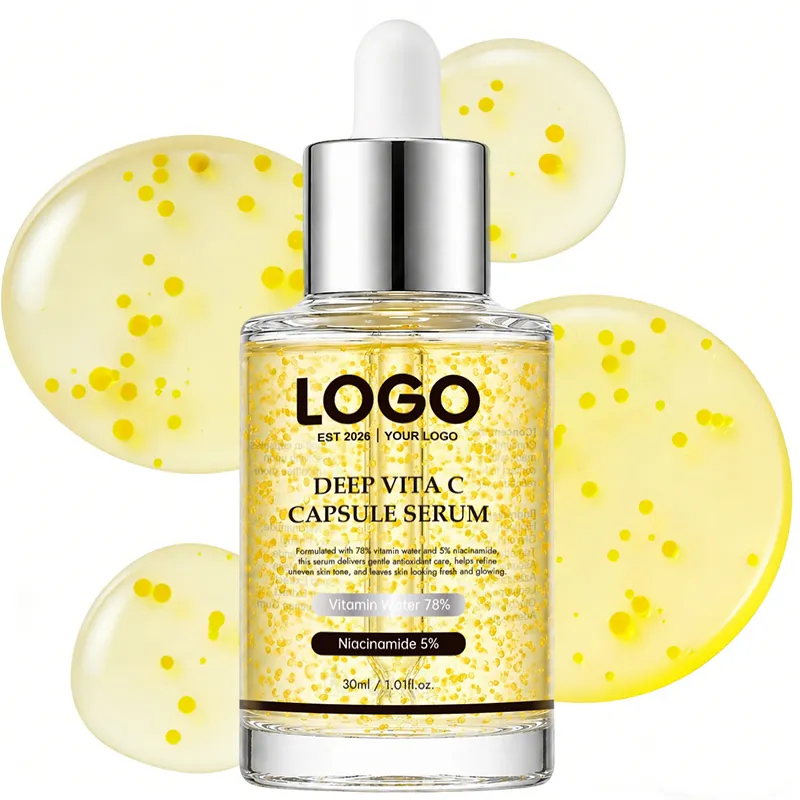
Look at our Deep Vita C capsule serum and you see a 30 ml dropper bottle of pale yellow gel with hundreds of small beads suspended in it. The gel is 78 percent vitamin water carrying 5 percent niacinamide at a buffered pH near 6. The beads are the vitamin C: a concentrated acidic core, encapsulated so it never mixes with the gel until the moment the serum is pressed onto skin.
Three consequences follow, and they are the whole commercial argument for this format:
- pH separation. Each phase keeps its own pH window. Neither active is compromised by the other’s requirements.
- Dose control. Beads are dosed by count, not by concentration, so the vitamin C delivered per pump is consistent rather than dependent on how well the gel was mixed.
- Colour stability. Ascorbic acid browns when it oxidises. Sealed inside a bead with limited headspace, it browns far more slowly than it would in an open bottle of serum.
Why “78% vitamin water” is a formulation statement, not a slogan
Water content in the gel phase decides two things: how the beads suspend and how the product behaves on skin. Below roughly 70 percent water the gel is stiff enough to hold beads but reads heavy and tacky on the face. Above 85 percent the beads sink and cluster at the bottom of the bottle within weeks.
The 78 percent figure is therefore a tuned value. It sits where the suspending agent can hold a bead load of several hundred per 30 ml without sedimentation over 36 months, and where the serum still spreads. That is the sort of number a formulator argues about for a week and a buyer never sees.
If a supplier quotes you a bead serum without telling you the suspending system, ask what happens at 40 °C for three months. Settling is not a cosmetic issue — it is a dose issue.
Where the process is difficult
Filling a bead suspension is the opposite of filling a normal serum. Three points on the line:
- Bead forming. The encapsulant is dropped or extruded into a setting bath, then cured. Bead size has to be tight: a 0.2 mm spread changes how the beads pack and how the pump behaves.
- Gentle filling. Standard piston fillers crush beads. Suspension filling uses a low-shear path and a wide-bore nozzle, and the line runs slower than an equivalent 30 ml serum.
- No in-line filtration. Obvious, and frequently forgotten by buyers who ask for a 5-micron filter as standard practice. That filter removes the product’s active.
What we test, and what the test proves
| Test | What it catches |
|---|---|
| Bead count per 30 ml | Under-dose from a filling drift |
| Bead integrity after filling | Crushed or leaking beads, which acidify the gel |
| Ascorbic acid assay in beads, t=0 and 3 months at 40 °C | Oxidation rate, and whether the pack is doing its job |
| Niacinamide assay in gel | Hydrolysis, which shows as a pH drop and a flush risk |
| Colour L*a*b* every month | Browning — b* moves before the eye notices |
| Patch test on 30 subjects | Irritation from the acidic phase once the bead breaks on skin |
The colour check is the one clients ask about most, because it is the failure a customer can see. A bead serum that has drifted from pale yellow to amber has lost most of its ascorbic acid, whether or not the label still claims it.
How the service side works
Bead-in-gel is a stock platform before it is a custom project. We hold bases for vitamin C with and without niacinamide, and a brand chooses the active load, the bead colour, the gel opacity and the label. Samples in seven days on the stock base; a new bead encapsulates in ten to fifteen. Minimum 500 pieces at 30 ml, 25 to 35 days after artwork sign-off, batch COA with the assay values rather than a generic statement.
If the brief needs a different acid — a PDRN spray, a TXA drop, a fermented essence — the same platform logic applies with a different core. The capsule serum category lists the variants, and this guide compares bead-in-gel against single-dose softgels and ampoules. For the niacinamide side of the pairing, see 5% versus 10% niacinamide.
The inquiry form takes a bead-count target and returns a costed proposal against a stock base.