A sun stick is the only sunscreen people reapply without being nagged. That behaviour is why the format keeps taking share in beach, sport and travel ranges. It is also why the format is harder to get right than a cream: everything that makes a stick pleasant — the wax, the glide, the absence of water — works against an even dispersion of UV filters.
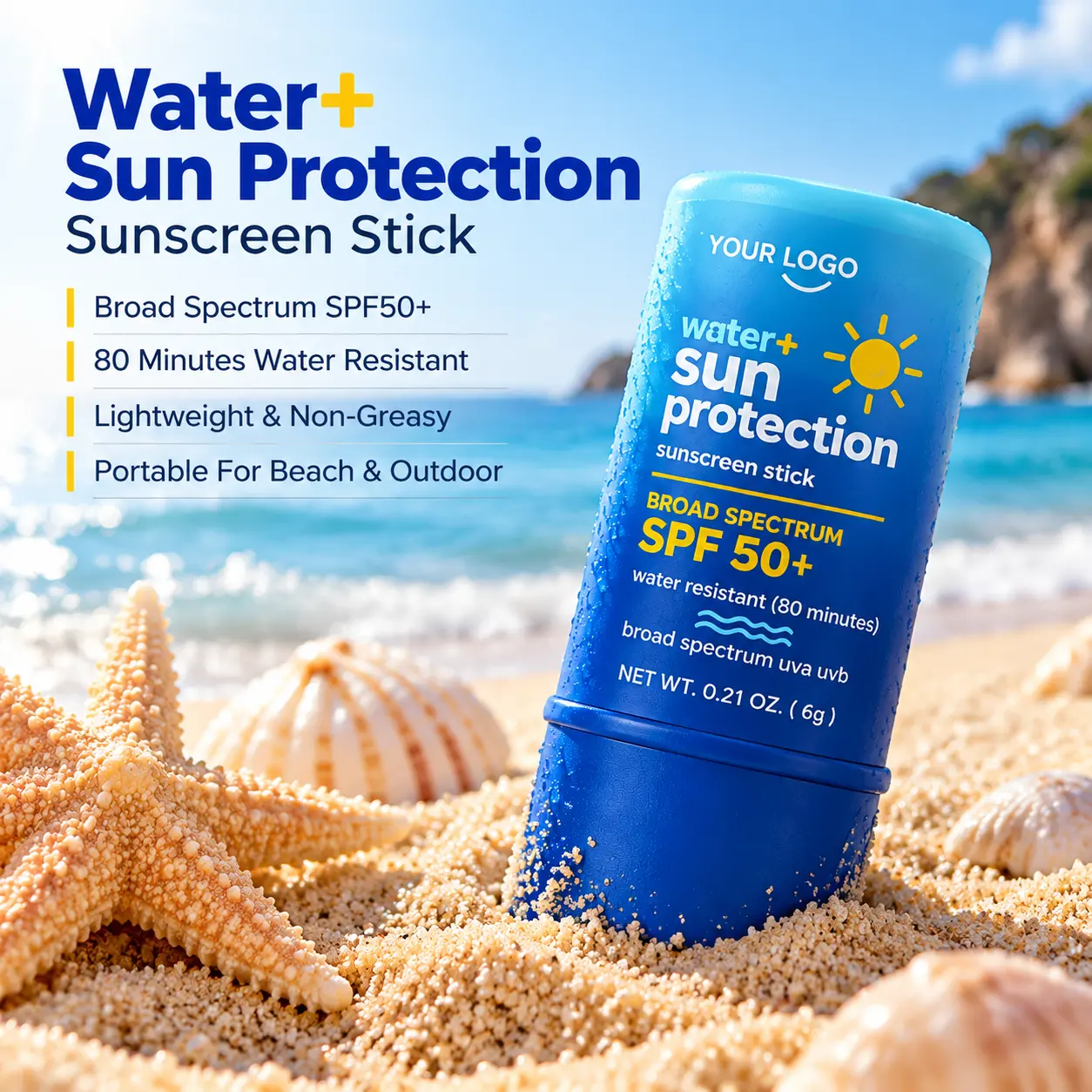
Our SPF50+ beach stick carries four claims on a 6 g barrel. Each one has a specific production and testing consequence.
Claim 1: broad spectrum SPF50+
SPF is a measurement, not an ingredient list. It comes from in-vivo testing to ISO 24444 on human subjects, and the UVA half comes from the in-vitro ISO 24443 method that produces the UVA protection factor and the critical wavelength used to justify “broad spectrum”.
What that means on the line: the filter blend has to be dispersed to a defined particle size and held there. An anhydrous stick has no emulsifier doing that job, so the dispersing agent and the mixing sequence carry the whole burden. A stick that tests SPF48 instead of 50 usually has a dispersion problem, not a filter shortage.
Claim 2: 80 minutes water resistant
Water resistance is tested by immersion and re-measurement, not by adding a water-repellent polymer and hoping. The film has to survive two 20-minute immersions and still hold its SPF. In an anhydrous stick this is the wax and oil phase doing the work — which is also why sticks hold water resistance more easily than lotions.
Claim 3: no white cast
This is the claim most often lost in formulation. Mineral filters scatter light and leave a cast on deeper skin tones unless the particle size and the oil phase are chosen to match. Chemical filters avoid the cast but need a solubilising system that does not crystallise at low temperature. A stick that whitens on the shelf at 5 °C will whiten on the customer’s face.
Claim 4: the stick does not melt in a beach bag
Not a regulatory claim, but a commercial one. Drop point of the wax blend is usually specified between 60 and 70 °C so the stick survives a car dashboard without going soft, while still gliding at skin temperature. That window is narrow, and it is the first thing a formulator adjusts when a market is hot and humid.
How it is filled
Sticks are hot-filled: bulk held at 65 to 75 °C, dispensed into the barrel, then cooled so the product sets in place. Three failure modes live here.
- Voids. Fill too cool and the stick sets before it reaches the bottom of the barrel.
- Underweight tips. The product shrinks as it cools, so an exact 6.0 g fill ends up visually short. We overfill by a controlled amount to land on the declared net weight after shrinkage.
- Bad domes. The tip is shaped by the cooling surface, not cut. A deformed dome cannot be corrected after sealing, so it is a batch reject.
All of this runs on our hot-fill lines, which also handle balms and compacts. The 500-piece minimum on sticks comes from shared moulds: the changeover between SKUs is a barrel and a label, not a new tool.
What the test programme looks like
| Stage | Test | Timing |
|---|---|---|
| Formula screen | In-vitro UV absorbance scan, critical wavelength | Days |
| Claim validation | ISO 24444 in-vivo SPF, ISO 24443 in-vitro UVA-PF | Weeks, per formula |
| Water resistance | Immersion protocol, 80 min | Weeks, once the base is frozen |
| Stability | 3 months at 40 °C, plus a freeze-thaw cycle | 3 months, parallel to production |
| Pack compatibility | Barrel deformation, drop test, label adhesion | Alongside stability |
| Batch release | Fill weight, appearance, micro, COA | Every batch |
The important sequencing point: freeze the base before running in-vivo SPF. A pigment grade swap or a wax change after the test is money spent twice, and the claim on the pack then describes a product you no longer make.
What a brand gets, and in what order
Stock base samples in seven days, so you can put the texture on skin before committing. Custom tints and filter blends in ten to fifteen. Then artwork, then 25 to 35 days to shipment, with the batch COA and the test summary travelling alongside. Markets differ on copy: the EU caps the claim at SPF50+, PA ratings come from the UVA-PF result, and the US runs sunscreens through the OTC monograph rather than the cosmetics framework. One formula can serve all three; one pack cannot.
The sunscreen stick category carries the tinted, mineral and travel formats, and sun care covers the cream and fluid versions. For how the same claims are verified batch by batch, read the tests a cosmetic batch passes.
Send your market and target SPF to the inquiry desk; the test plan follows from the market, not the other way round.