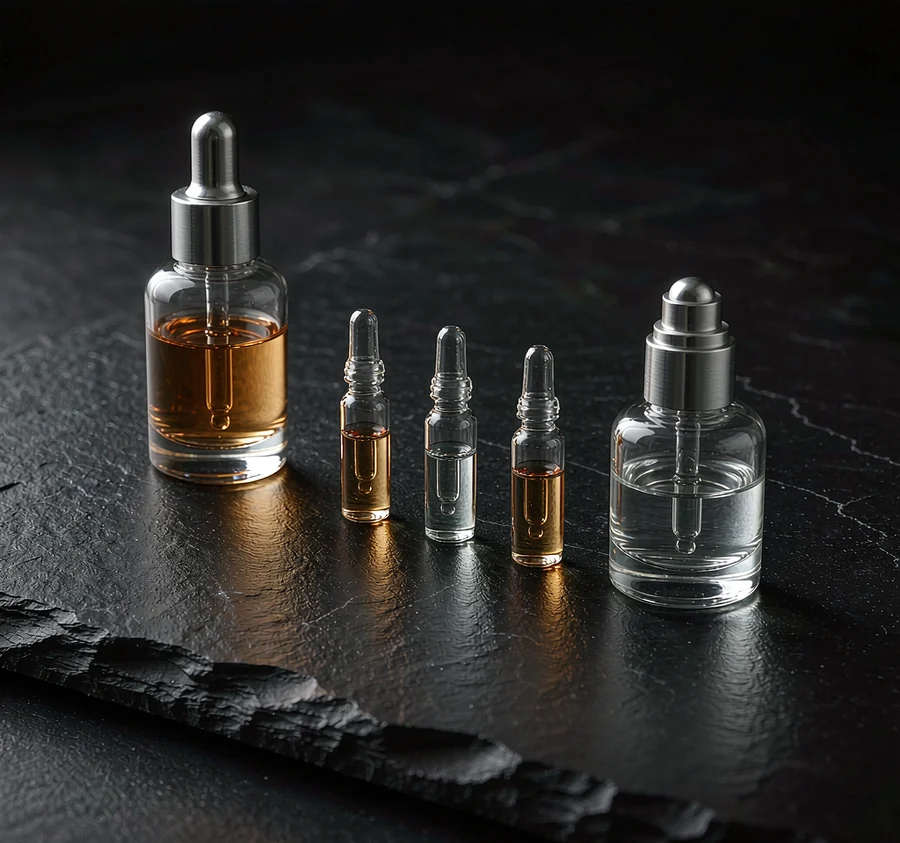
Key takeaways
- Glycolic acid works at 5-10 percent, and only below pH 4, where half stays un-ionised.
- Salicylic acid runs at 0.5-2 percent; most markets cap leave-on products at 2 percent.
- Hyaluronic acid does not exfoliate; at 0.1-1 percent it offsets a low pH's tightness.
- Low pH collapses carbomer, so pick the thickener for the pH, not for the feel.
- Prove preservation at the final pH; a system that holds at pH 6 can fail at 3.8.
An acid serum is usually sold as one product but built from three actives that fail in different ways. Glycolic acid needs a low pH to stay active, salicylic acid needs a solvent to stay in solution, and hyaluronic acid is there to make the result tolerable. Get the doses and the pH range right and the formula is stable; get one wrong and the failure shows up as a thin gel, a gritty bulk or a product that stings.
| Active | Leave-on dose | Job | Fails when |
|---|---|---|---|
| Glycolic acid | 5–10% | Surface resurfacing, texture | pH drifts above 4 |
| Salicylic acid | 0.5–2% | Pore and oil control | Recrystallises as the bulk cools |
| Sodium hyaluronate | 0.1–1% | Water binding, after-feel | Hydrolyses at low pH over months |
1. Three actives, three jobs
Glycolic acid is the smallest alpha-hydroxy acid, and that size is the whole point: it reaches the upper layer of dead cells quickly instead of sitting on the surface. Salicylic acid is oil-soluble, which lets it travel into a pore that water-based acids cannot enter. Sodium hyaluronate does no exfoliating at all; it binds water and takes the tight, papery feel off a low-pH product. A formula that treats these three as interchangeable will read well on a spec sheet and behave badly on skin.
2. Glycolic acid, at dose
Leave-on products typically sit between 5 and 10 percent. Dose alone decides very little, because glycolic acid only acts in its un-ionised form: with a pKa near 3.8, about half the acid is un-ionised at pH 3.8, and roughly a fifth at pH 4.5. That is why a 10 percent formula at pH 4.6 performs like a 5 percent one at pH 3.7. Below 4 percent the effect is mostly hydration and texture. Above 10 percent the sting and the photosensitivity warning become the dominant feature, and buffering has to be built in deliberately.
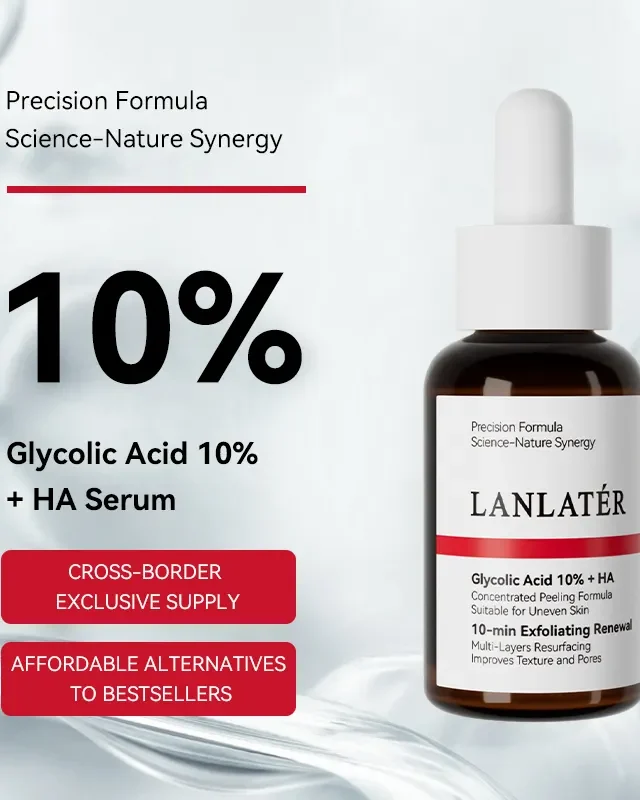
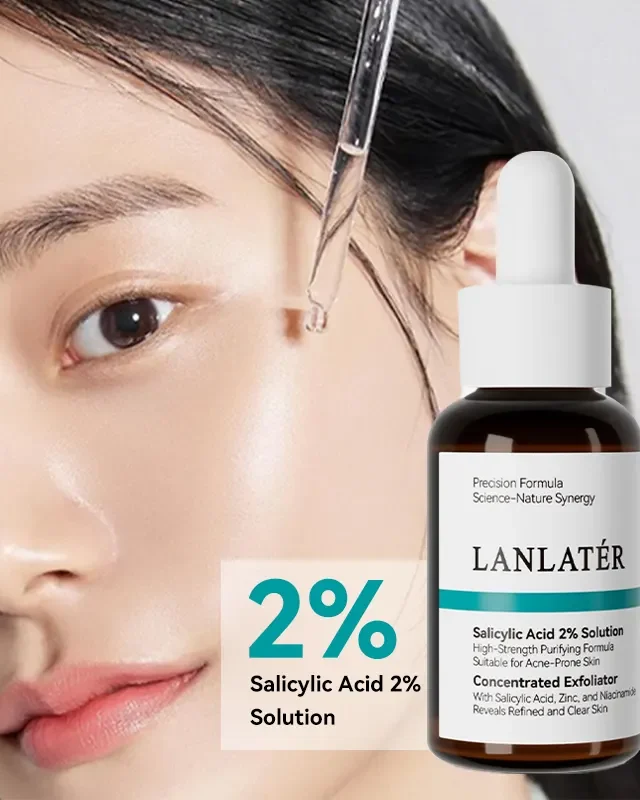
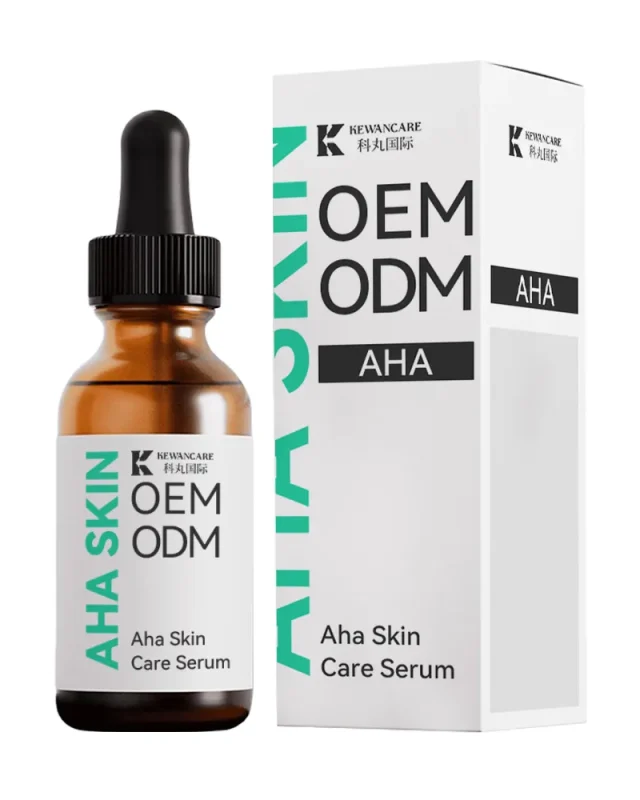
Product in our range: AHA and BHA serum
 |  |  |
Private label acid serum, MOQ from 1,000 pieces
Dropper bottle or ampoule · 36 months unopened · ISO 22716 and GMPC · loading from Nansha or Shekou
Three stock directions are shown above: a 10 percent glycolic and hyaluronic build, a hyaluronic and salicylic serum, and an 8 percent glycolic gel.
3. Salicylic acid, at dose
The working range is 0.5 to 2 percent, and most markets cap leave-on products at 2 percent, so 2 is a ceiling rather than a target. Salicylic acid is only weakly water-soluble, which is why it is carried in glycols or a small amount of alcohol and why it can crystallise when a bulk cools slowly or when the pH falls further than intended. A formula that passes at release and shows grit at month three usually lost solubility, not potency. Screening the bulk through a fine mesh before filling catches most of it.
4. Hyaluronic acid, at dose
Sodium hyaluronate is used at 0.1 to 1 percent, and the grade matters more than the number. High-molecular grades sit on the surface and give slip; low-molecular grades penetrate further and feel less film-forming. Neither exfoliates. Its real job in an acid serum is comfort: it holds water in the film so the product does not dry down to a sting. At the bottom of the range the effect is barely measurable, and at the top the serum turns stringy and slows the filling line.
5. What the combination can claim
The defensible claims are mechanical and specific: exfoliating, smoothing rough texture, refining the look of pores, and hydrating. Each maps to an active at a stated dose and a pH range that makes the dose real. Claim wording should name the mechanism rather than the outcome, because “exfoliates” can be supported by a dose, while “resurfaces like a clinical peel” cannot. Where a brand wants a visible-results claim, a corneometer or a profilometry study on the finished formula is the honest route.
6. What it cannot claim
Acid serums cannot claim to treat or cure acne in most markets without being regulated as a medicine, and “whitening” is restricted or reworded in several destinations that the brand may be exporting to. Nor is the product equivalent to a professional peel: the free-acid load and the contact time are different by an order of magnitude. Photosensitivity advice belongs on the pack for AHA products, and an acid serum is not a substitute for sunscreen. Where a brief asks for one of these claims, the formula usually has to change, not just the wording.
7. Stability and compatibility
Low pH is what breaks most acid serums, and it breaks them slowly. Carbomer needs neutralisation to build viscosity, so at pH 3.8 it simply does not thicken; a crosslinked acrylate or xanthan gum holds instead. Preservatives behave differently too, since benzoic and sorbic acid are far more effective at pH 4 than at 6, while phenoxyethanol is pH-tolerant but weak against moulds. Hyaluronate chains hydrolyse over months at low pH and elevated temperature, which reads as a serum that thins rather than spoils. Every one of these shows up in a three-month 40 degree test, not at release.
8. Cost impact of dose
Glycolic acid is one of the cheapest actives in the catalogue, so moving from 5 to 10 percent changes the bulk cost by very little. Salicylic acid sits in the middle. Sodium hyaluronate is the line that moves: at 0.1 percent it is a rounding error, and at 1 percent of a high-molecular grade it can be the largest single ingredient cost in the formula. The rest of the unit price is packaging, and a dropper bottle or an ampoule usually costs more than the liquid inside it. Spend the budget on the pack and the test work before spending it on a higher acid dose.
9. Where it fits
Acid serums sit under AHA and BHA serum, alongside the lighter formats under facial essence. Background notes on pH, thickeners and preservation are filed in encyclopedia.
Reference: Formulation development notes, 2025