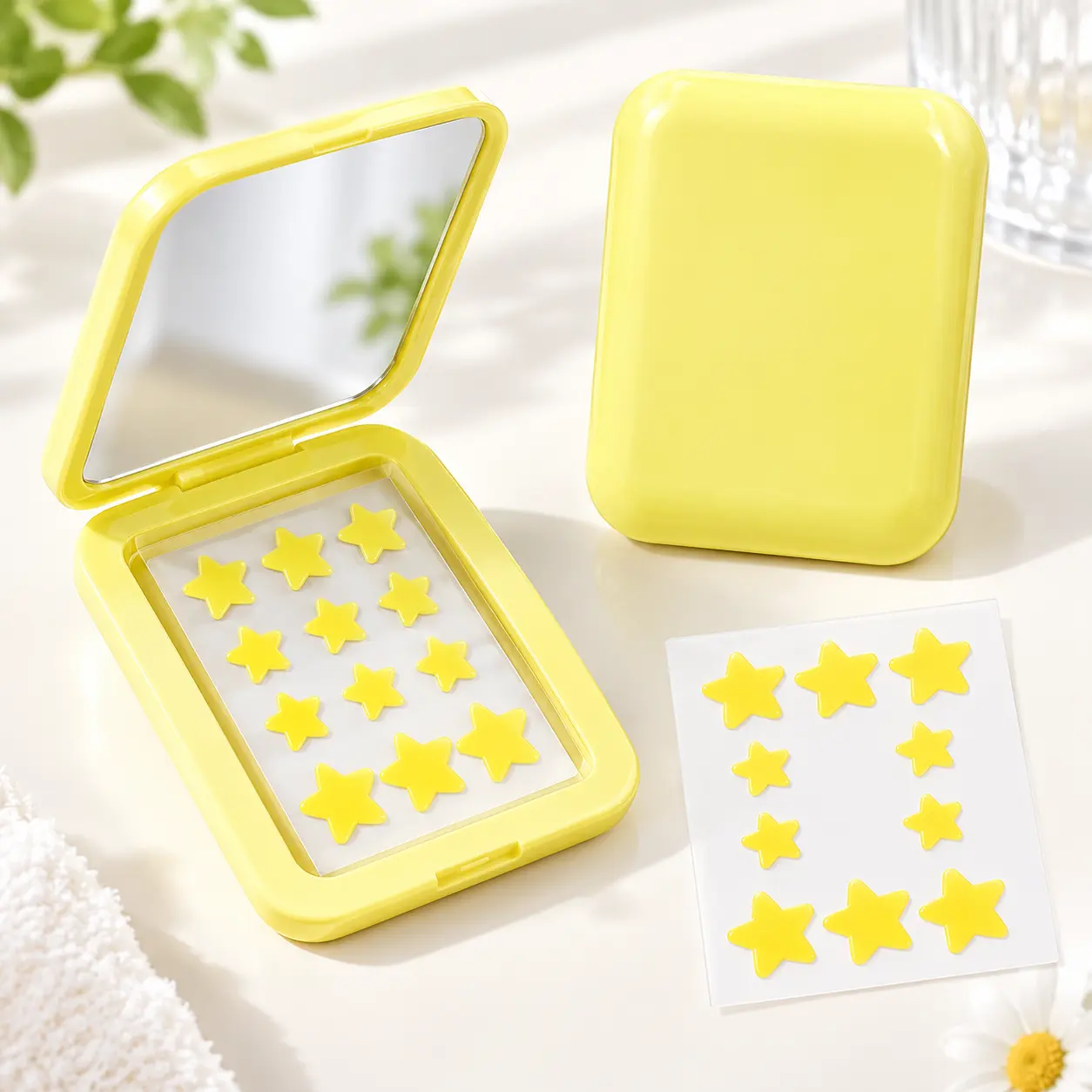
A hydrocolloid patch that has turned milky white by morning has done the work it was bought for. One that has dried at the edges and lifted has not. That colour change is the mechanism made visible: fluid from a spot has been absorbed into the patch and gelled inside it. Everything else about the format – the die-cut sheet, the foil pouch, the mirror-finish retail box – exists to deliver that one physical event reliably, batch after batch. Our salicylic acid hydrocolloid patch is the version we run most often, and it repays being taken apart layer by layer.
The matrix: an adhesive that absorbs
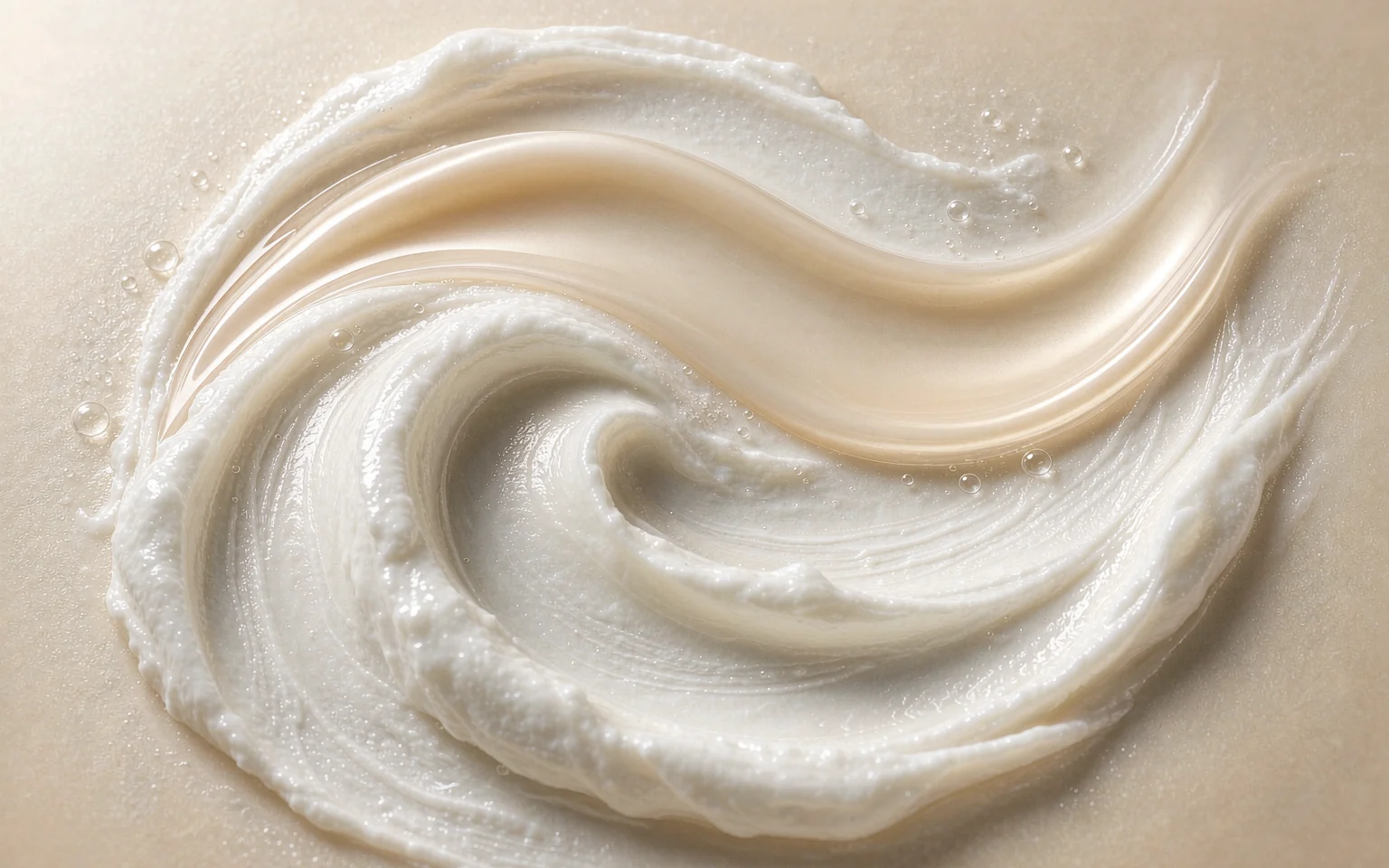
A hydrocolloid is not a plaster with ointment on it. It is a dispersion of absorbent particles – usually sodium carboxymethyl cellulose – inside a rubbery adhesive such as polyisobutylene, coated onto a film at roughly 0.3 to 0.6 mm. Dry, it is translucent and faintly amber. When water arrives from the skin, the cellulose particles swell, the matrix turns opaque white, and the patch holds that fluid against the spot instead of letting it dry into a crust.
The moist environment matters more than the absorption figure. A spot left to dry into a hard scab gets picked; one kept under hydrated gel stays flat and settles with less visible residue. That is a mechanical effect, and it is why plain patches with no actives still sell in volume.
The backing film: what stops the gel drying out
The film is a matte polyurethane, thin enough to follow the curve of a jaw and opaque enough to blur what is underneath. Its real job is to close the top face of the matrix so moisture leaves only through the skin side. A film that is too breathable turns a patch into a drying poultice within a night.
The edge decides whether the patch survives until morning: a hard cut edge lifts within hours wherever skin moves, while a tapered edge and a matrix marginally thicker at the centre are what make the invisible claim credible.
Where the salicylic acid sits, and what it can reach
Salicylic acid is a keratolytic. It loosens the desmosomes holding dead corneocytes together and softens the plug sitting at the opening of a follicle. In a patch the dose is low and the contact time is long – six to ten hours overnight, not the two minutes a toner gets before it is rinsed away. That combination is why the acid can do something here that a stronger leave-on product does not do as comfortably.
What it buys is surface clearance, and the reduced temptation to squeeze the spot is worth more than the acid itself. What it cannot do is reach a follicle two millimetres under the skin, because the patch contacts the stratum corneum and delivers over a very short diffusion distance.
The limits worth writing into the brief
Nodules, cysts and blind pimples sit below the reach of any patch. A pack claiming a cure for those will generate returns and, in the EU and ASEAN markets, a claim complaint. Write the copy around what the format does: it protects, it drains a surfaced spot and it discourages picking.
How a batch is built
- Coating. The hydrocolloid mass is coated onto the backing film at a controlled wet thickness. Thickness is absorption capacity, and it is measured on the roll rather than eyeballed at the end.
- Conditioning. The coated roll passes through a humidity-controlled room so the matrix settles to its target moisture before anything is cut. Cut it too dry and it curls; too wet and it blocks in the die.
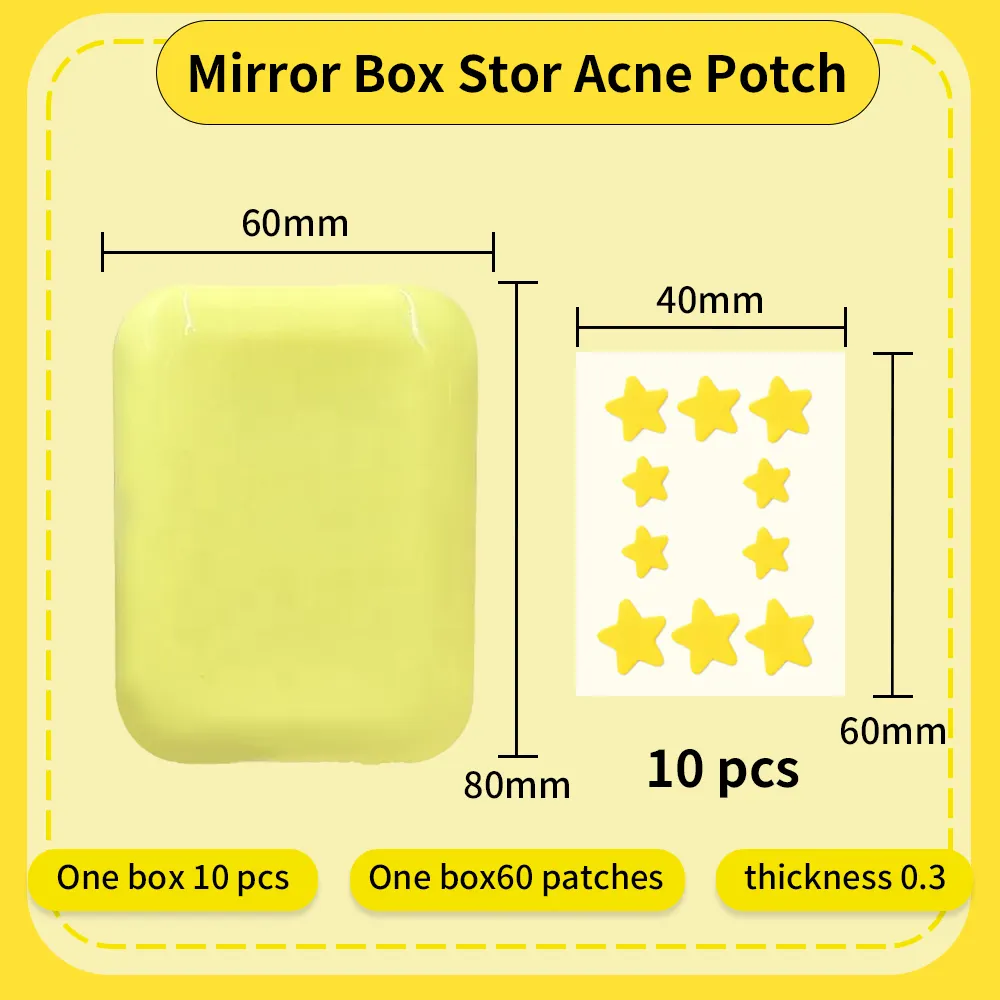
- Lamination and die-cutting. Release liner applied, then the sheet cut to the layout: patch shapes, registration marks, and the gaps that let a customer peel one without disturbing its neighbour.
- Pouching. One sheet per foil pouch, sealed and coded. Seal quality is the whole game here – a patch in a leaking pouch is a stiff amber film by the time it reaches a shelf, and the customer reads that as a formula failure.
- Cartoning. Pouches into the retail carton, with the batch code and expiry on the pouch itself, not only on the box.
What we measure before release
| Check | Method | Why it matters |
|---|---|---|
| Matrix thickness | Micrometer on coated roll, start and end of run | Sets absorption capacity and how the patch sits on skin |
| Fluid uptake | Weighed patch, hydrated for a fixed time | A patch that absorbs little leaves the spot wet and lifts |
| Peel adhesion | Peel test on artificial skin at 35 °C | Predicts whether it survives a night on the jaw |
| Seal integrity | Dye penetration on the pouch | A leak dries the patch out before it is sold |
| Micro | ISO 17516 limits | Every batch, before release |
| Stability | 3 months at 40 °C, plus a real-time arm | Catches adhesive creep and colour drift in the pouch |
What a working brief contains
The minimum on this format is 3,000 pieces, in tiers up to 100,000 and beyond. The primary pack is a foil pouch; the mirror box in the listing name is the retail carton built around it, and that is where a brand puts most of its design budget because the pouch is what the customer actually opens. Lead time is 25 to 35 days after artwork sign-off, shelf life 36 months unopened and 12 months after opening, and a batch COA travels with every shipment.
Stock-base samples go out in seven days so a brand can wear the patch for a night before committing to a print run; a new shape means new tooling and ten to fifteen days. The coating and pouching sit under one roof at our Qingyuan factory, which is ISO 22716 and GMPC certified, and the same audit covers the micro laboratory that signs each batch off. For the documentation that travels with the pallet, the sequence is set out in the tests a cosmetic batch passes.
Send the sheet layout, the carton and the market to the inquiry desk and we will cost the pouch and the box separately, which is the only way to see where the money actually goes.