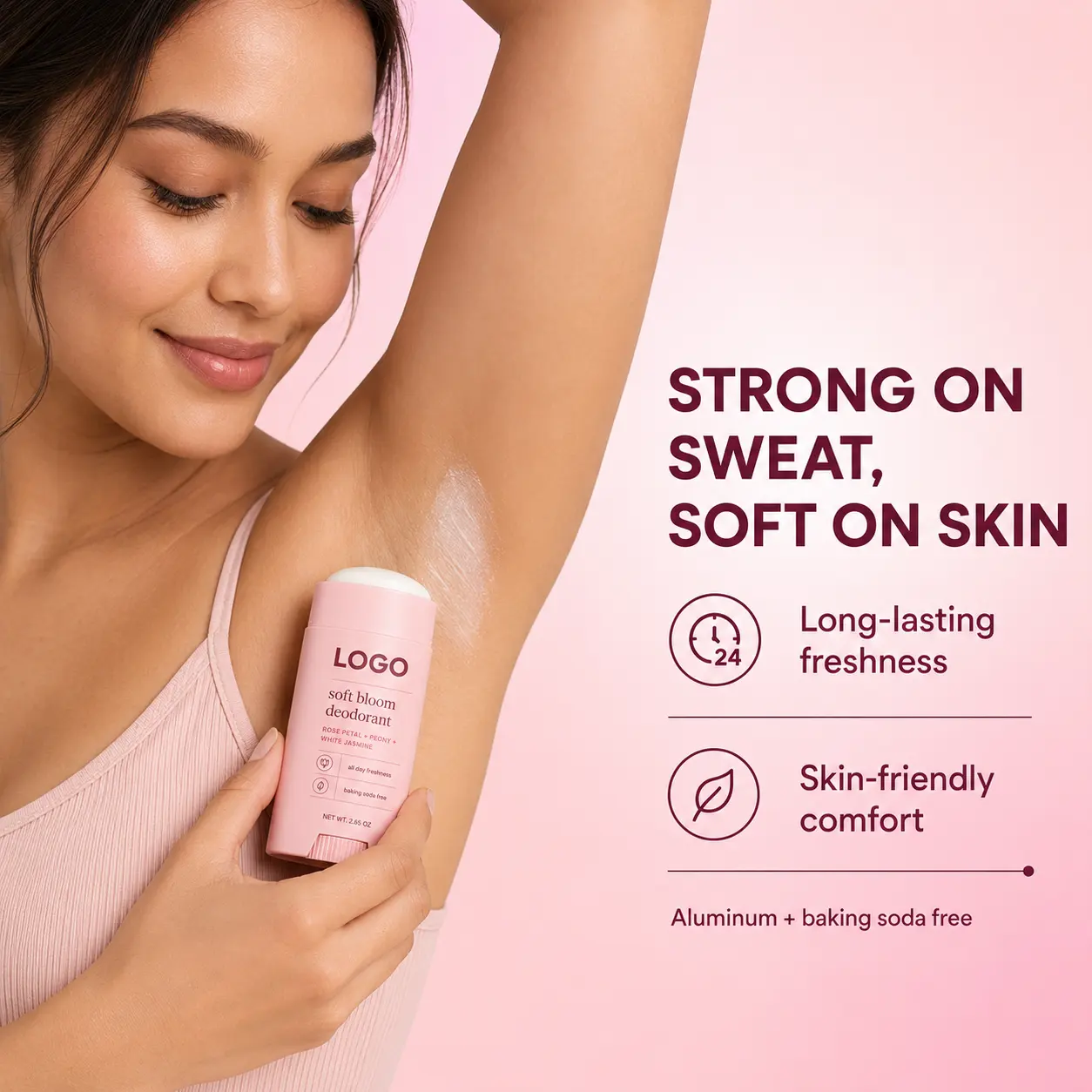
Twenty-four is the number printed on the pack, and it says nothing about how much you sweat. A deodorant is judged on a different quantity altogether: the concentration at which a trained nose can pick up what bacteria have made of the sweat. Miss that threshold and the product fails at hour nine, however much fragrance it carries. Our Soft Bloom daily deodorant is formulated around that threshold rather than around a scent story, and the difference is where the money goes.
Odour is a conversion, not a volume
Fresh sweat is close to odourless. What smells is what skin bacteria do to it: corynebacteria and staphylococci hydrolyse sweat lipids and release volatile fatty acids, chiefly isovaleric acid and propionic acid, along with a family of thioalcohols. The human nose detects isovaleric acid in the low parts per billion, which is a very low bar and the reason a warm room can turn a clean shirt into a problem in three hours.
Once you accept that, the whole product category reorganises. The question is not how much perspiration the underarm produces but how long the volatile compounds can be kept under the detection line. Every decision on the line follows from that number.
Three levers, one of which actually holds for 24 hours
Reduce the substrate. Less lipid available to the bacteria means less conversion, which is why some formulas lean on absorbent powders rather than on actives.
Slow the conversion. Antimicrobial actives, and odour-binding compounds such as zinc ricinoleate, attack the process itself. Fragrance oils at a high enough load also inhibit growth, but the load needed is well beyond what a perfumer would choose for scent alone.
Stay under the line by masking. A fragrance does not remove the molecule; it competes for the same receptors. It is the cheapest lever, it is the one customers judge in the first hour, and it is the first to collapse after twelve.
Rank the levers by cost and by endurance, and the honest ordering is: masking is cheap and short, antimicrobial is expensive and long. A 24-hour claim lives or dies on the second.
The four claims, each with its measurement
| Claim on the pack | What is actually measured | Typical protocol |
|---|---|---|
| 24-hour odour protection | Odour intensity scored by trained assessors | Panel at baseline, 8 h and 24 h, 0-5 scale, against an untreated control |
| Quick dry | Residue and tack after application | Timed dry-down on forearm, blot weight of residual film |
| Stain free | No white mark on dark fabric after dry-down | Standardised application on black cotton, visual grading after 24 h |
| Sensitive skin safe | No reaction under occlusion | Patch test on 30 subjects, or HRIPT where the brief demands it |
The stain claim deserves a note. A formula that manages odour rather than blocking the duct leaves a thin film with no salts to precipitate, so it does not chalk a black shirt. If a brief asks for antiperspirant behaviour instead, the stain test becomes a different test, and the market rules change with it – the EU treats antiperspirants as cosmetics while the US runs them through the OTC monograph.
Where a 24-hour formula breaks
Almost never at hour one. The failure sits between hours twelve and eighteen, when the antimicrobial has been consumed, the fragrance has flattened, and the skin surface pH has drifted upward as the day goes on – and a higher pH favours the bacteria that produce the thioalcohols. Reading panel scores as a curve rather than a pass or fail is the only way to see which of the three levers gave way first.
The practical consequence for a brief: ask for the 8-hour and 24-hour scores separately. A formula that scores 1 at eight hours and 3 at twenty-four has a depletion problem. One that scores 2 at both has a starting-load problem. They are fixed by different changes, and a supplier who cannot tell you which one you have is guessing.
From 100 pieces to a pallet
Minimum on this format is 100 pieces, in tiers through 1,000, 5,000 and 20,000+. The sequence is short because the product is simple: blend the base at 60 to 70 °C until uniform, cool below 45 °C before adding anything heat-sensitive, adjust pH into the target window, then fill, cap, label and carton. Batch release covers fill weight, pH, appearance, micro to ISO 17516 limits, and a panel check against the retained reference from the approved sample.
Lead time is 25 to 35 days after artwork sign-off, shelf life 36 months unopened and 12 months after opening, and stock-base samples go out in seven days so a brand can test the dry-down on real skin before printing a carton. The filling lines and the panel room sit in the same building at our Qingyuan plant; the documentation that travels with each pallet is described in the batch test sequence.
Bring the market, the claim wording and the pack to the inquiry form; the panel protocol is written from the claim, so it is cheaper to settle the sentence before the formula.