A body wash order rarely fails on the price per bottle. It fails on the numbers a buyer did not ask for before signing: the true minimum once print and fragrance are involved, what a sample actually changes, which documents travel with the container, and who absorbs the cost when a batch misses its colour target. These eight questions come up in almost every first call.
| Minimum order, stock bottle | 100 pieces |
| First sample, stock base | 10–15 days |
| Production after artwork sign-off | 25–35 days |
| Shelf life, unopened | 36 months |
| Bases on file | 5,000+ |
1. What is the real minimum order?
On a stock base and a stock bottle the floor is 100 pieces, and the published tiers run 100–999, 1,000–4,999, 5,000–9,999 and 10,000-plus pieces. Two things move that floor. A new mould or a bespoke bottle starts at 1,000 pieces, because the tool has to be cut and sampled. A fragrance outside the stock library moves it as well, since an oil house sells in minimum quantities that a 300-piece run cannot absorb. Ask for the minimum on your exact combination rather than the catalogue headline.
2. Can I change the formula, or only the artwork?
Three levels. A stock base with your label is the fastest and the cheapest. A tweaked base changes what the brief genuinely needs: surfactant ratio for foam density, a different thickener for a gel or a lotion feel, actives at your dose, and pH moved to suit a claim. A full custom development starts from the brief and adds a second sample round. With more than 5,000 bases on file, most briefs land in the middle tier. What cannot be swapped casually is the preservative system, because a new preservative needs a new challenge test and that adds two to three weeks.
3. How fast is a sample, honestly?
Ten to fifteen days for a first sample from a stock or tweaked base, then three to five days for each revision. If only the fragrance changes on a stock base, it can be quicker. What slows a sample down is rarely the lab. It is a brief that arrives in three parts over two weeks, or a colour target given as a phone photo of another brand’s bottle instead of a Pantone reference the lab can match.
Product in our range: shower gel and body wash
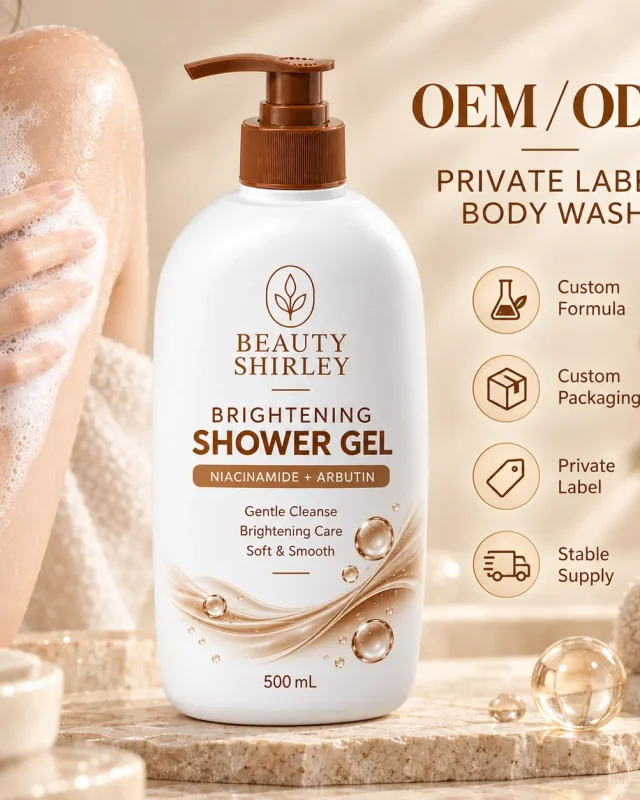 |  |  |
Private label body wash, MOQ from 100 pieces
Stock or bespoke bottle · 36 months unopened · ISO 22716 and GMPC · loading from Nansha or Shekou
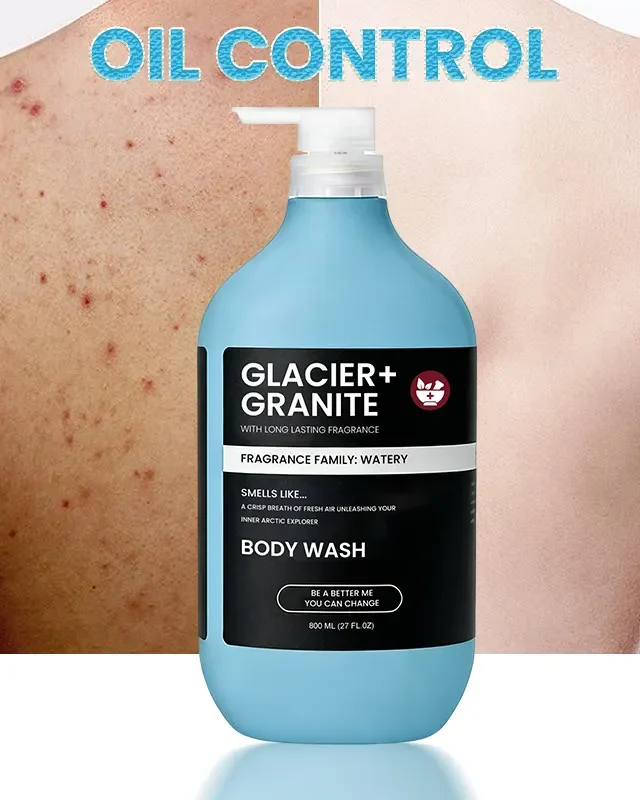
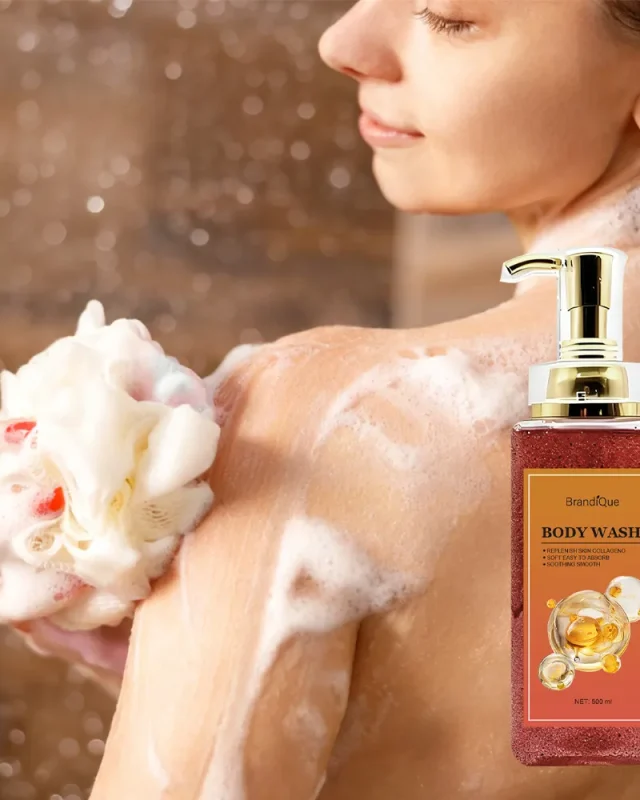
Three stock directions are shown above: a niacinamide and arbutin cleanse, a pH-balanced cooling gel, and a glutathione brightening base.
4. What happens if my market restricts an ingredient?
Screening belongs before the sample, not after. The usual friction points are preservatives, colourants and a small group of actives that are permitted in one market and capped or excluded in another. The destination market goes on the brief, and the formula is checked against it before anything is made. When an ingredient has to go, the substitute is chosen for the same function rather than the same name, because swapping one preservative class for another usually changes the pH tolerance and invalidates the challenge test.
5. Who writes the documents?
Each batch ships with a certificate of analysis covering appearance, pH, viscosity and microbial limits, plus a stability file for the format. The product information file, CPNP notification, FDA listing, safety data sheet and the IFRA certificate for the fragrance are prepared in-house rather than through an outside agency, which matters when a customs broker asks for a document at short notice. What is not written for you is the label claim: that wording stays your regulatory responsibility, and a claim the formula cannot support will be flagged before print.
6. What does a reorder cost?
A straight reorder repeats the formula, the bottle and the artwork, so no tooling and no sampling is charged. The unit price follows whichever tier the quantity falls into, and the lead time stays at 25 to 35 days after artwork sign-off. The trap is packaging. A bottle bought at its minimum for a first run often has its own minimum for a second, and a short sleeve reprint can cost more per unit than the first print did once the quantity halves.
7. What can go wrong, and who pays?
Three failures account for most complaints: a shade that drifts between batches, a viscosity that reads low on the filling line and high in the bottle a week later, and a pump that leaks in transit. Shade and viscosity are the factory’s problem when the batch falls outside the approved standard, and it is reworked or replaced. A pump chosen for cost against advice is not. That is why the approved standard is signed before the first production run and retained samples are kept: an argument about colour needs a reference, not a memory.
8. What do I send to get a price?
Six inputs: the product type and the feel wanted, the bottle or pack in mind or a reference for it, the destination market, the quantity for the first order plus an annual estimate, the claim the brand wants to lead with, and whether artwork already exists. With those six, a quotation comes back with a tier price, a sample date and a production window. Without them the reply is a range, and a range is what every other supplier is also sending.
9. Where it fits
Shower gel and body wash formats sit under body wash, with scrubs and butters under body scrub and body butter. Production notes are filed in news.