A brief often arrives as one sentence: SPF30, a UVA rating and a whitening claim, in one product. The answer is yes — but the next question decides everything else, and it is the one most briefs skip: which format?
That answer sets the fill weight, the filter load, the test budget and the shelf story. The same brief solved as a lotion, a stick and an impregnated pad produces three different products, and only two of them are good ideas.
The brief, in numbers
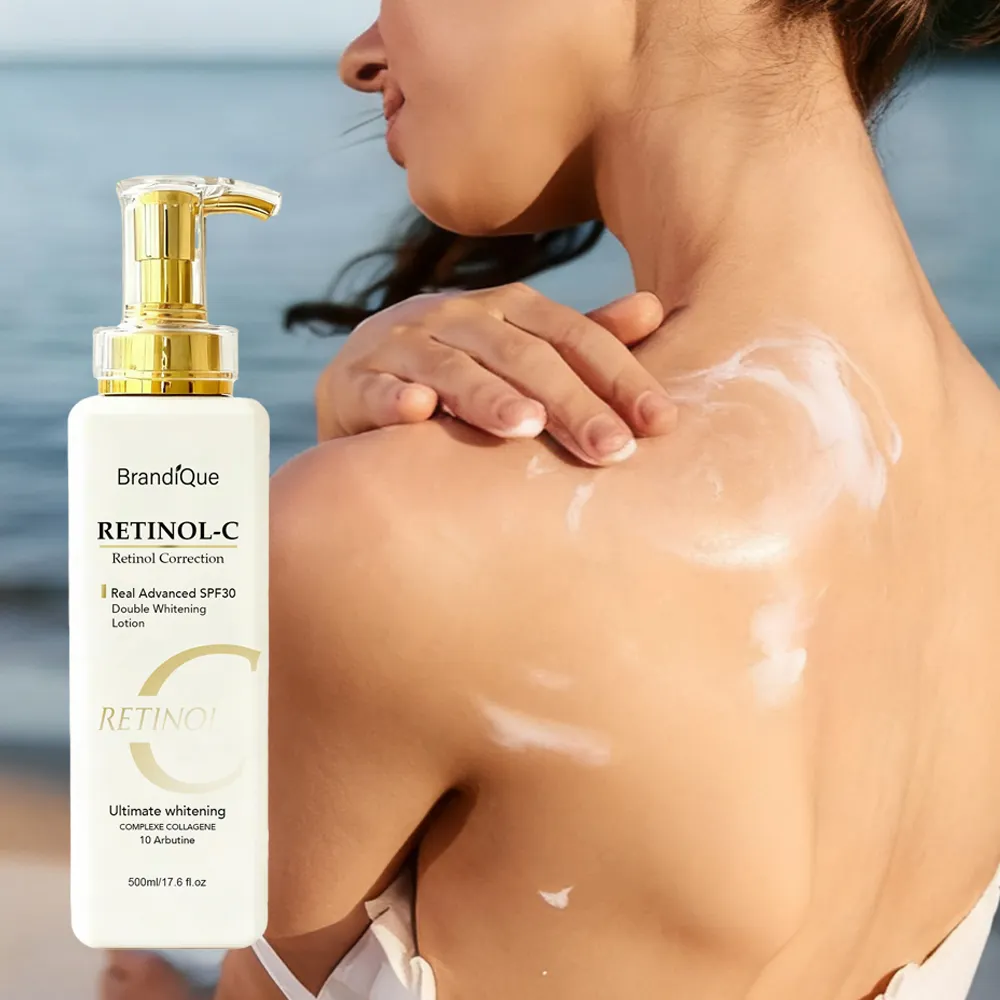
A daily-use face product with SPF30, a UVA rating, and actives that support a brightening story — retinol, arbutin, vitamin C and angelica in the case of our SPF30 double whitening lotion. Retinol and vitamin C are the awkward pair: one is light and heat sensitive, the other is pH sensitive, and both have to survive next to a filter system that wants its own solvent balance.
Lotion: the default, for good reasons
A 50 g tube or a 30 ml pump holds enough filter to reach SPF30 without turning the texture to paste, and it spreads to the two milligrams per square centimetre that the in vivo method assumes. The compromise is the emulsifier system: filters are oil-loving, actives are often water-loving, and the emulsion has to keep both stable for 36 months. In practice the lotion is the format that can carry the most claims simultaneously, which is why the brief usually lands here.
Stick: wins on reapplication, loses on dose
A stick is the honest answer to the question of how to get people to reapply. It travels, it cannot leak, and it puts a measurable layer on the cheekbone in one stroke. It is also the hardest format to test, because the amount applied in real use varies enormously, and a 15 g stick that claims SPF50+ has to prove the film thickness in the lab rather than assume it. The 6 g sun stick note walks through where that figure comes from.
Pad: the format that cannot hold a filter
An impregnated cotton pad carries roughly 1 to 2 g of liquid across a 60 mm disc. To reach SPF30 the pad would need a filter load far above what a toner-style liquid can hold without becoming tacky, and the applied film would depend on how hard the user presses. A pad is excellent for a brightening toner step; it is not a sun product. If a brand wants both, the answer is two SKUs, not one.
| Format | Typical fill | Filter load it can carry | Best claim set |
|---|---|---|---|
| Lotion / emulsion | 30 to 50 g | SPF30 to SPF50+ with UVA-PF rated | Daily sun protection plus brightening actives |
| Stick | 10 to 20 g | SPF50+ achievable, film thickness critical | Reapplication, outdoor, handbag |
| Impregnated pad | 1 to 2 g liquid | Not viable as a primary sun product | Brightening, exfoliation, soothing |
The test sequence is not negotiable
SPF is measured in vivo on human panels under ISO 24444, and the UVA protection figure under ISO 24443. Neither can be replaced by an in vitro estimate on a label. The brightening claim needs its own instrumented evidence — typically a melanin index or ITA° reading over eight to twelve weeks — and the retinol needs an assay plus a stability file showing what is left at month 36. Four test streams, four budgets, and the lotion is the only one of the three formats that can carry all four simultaneously.
Actives also need a threshold conversation. Niacinamide at 2 percent and at 10 percent are different products with different tolerances, as the niacinamide guide sets out; arbutin and retinol have their own ceilings, and a formula that stacks all of them at the top of their ranges is usually unstable rather than impressive.
What we quote and what we hold
This lotion category starts at 1,000 pieces, in three tiers up to 10,000+, with a 25 to 35 day lead time after artwork sign-off and a batch COA with every order. The sunscreen range covers lotion, stick and spray formats, and the production halls run the emulsion and the filling on the same site.
Send the market and the claims you intend to print. The format follows from the claim set, not the other way round — a two-line brief gets a costed answer rather than a catalogue page.