Key takeaways
- 2 percent covers sebum control; 4 to 5 percent covers tone; 10 percent is a marketing number.
- Finished pH between 5.5 and 7.0 prevents hydrolysis into nicotinic acid, which causes flushing.
- The label percentage is only honest if the bulk assays within tolerance of it.
- Niacinamide cannot share a low-pH phase with vitamin C — separate the two or isolate one in a bead.
“10% niacinamide” is a lab result printed on a carton. Between the intention and the carton sit a buffer, an assay, a stability run and a claim review. Understanding that chain is how a brand avoids buying a number that means nothing.
What the percentage buys
Niacinamide is a NAD precursor. Topically it does four things with reasonable evidence: it reduces sebum excretion, increases ceramide synthesis, interferes with melanosome transfer, and moderates inflammatory signalling.
| Level | What it does | Comment |
|---|---|---|
| 2% | Sebum control, barrier support | Best evidence per unit cost |
| 5% | Tone evening, post-blemish marks | Where most tone studies sit |
| 10% | Nothing extra | Higher irritation and cost; a positioning decision |
There is no dose-response above roughly 5 percent. What rises instead is the chance of stinging, the cost of the raw material, and the risk of recrystallisation in a cool warehouse.
Why pH decides whether it stings
In acid conditions niacinamide hydrolyses to nicotinic acid, which dilates capillaries. Users describe it as a warm flush within minutes of application. The reaction is negligible at pH 6 and material below pH 5.
Three rules follow:
- Buffer the finished formula to 5.5–7.0 with citrate or phosphate.
- Do not co-formulate with glycolic, lactic, salicylic or L-ascorbic acid in the same phase.
- If the brand wants both actives, separate them — two products, or a bead-in-gel format that isolates the acid inside the bead.
How the factory makes the number true
Four controls, in order:
- Raw material. Certificate of analysis from the supplier, plus an identity check on arrival. A niacinamide that arrives at 98 percent purity is not the same as one at 99.5.
- Charge calculation. The formula is written on active mass, not on raw material mass. This is where the arithmetic usually goes wrong.
- Bulk assay. HPLC on the finished bulk, against a calibrated standard. Released only if the result is within ±5 percent of the label claim.
- Stability assay. Re-run at one and three months at 40 °C. Niacinamide is stable if the pH holds; a drop here means the buffer failed, not the active.
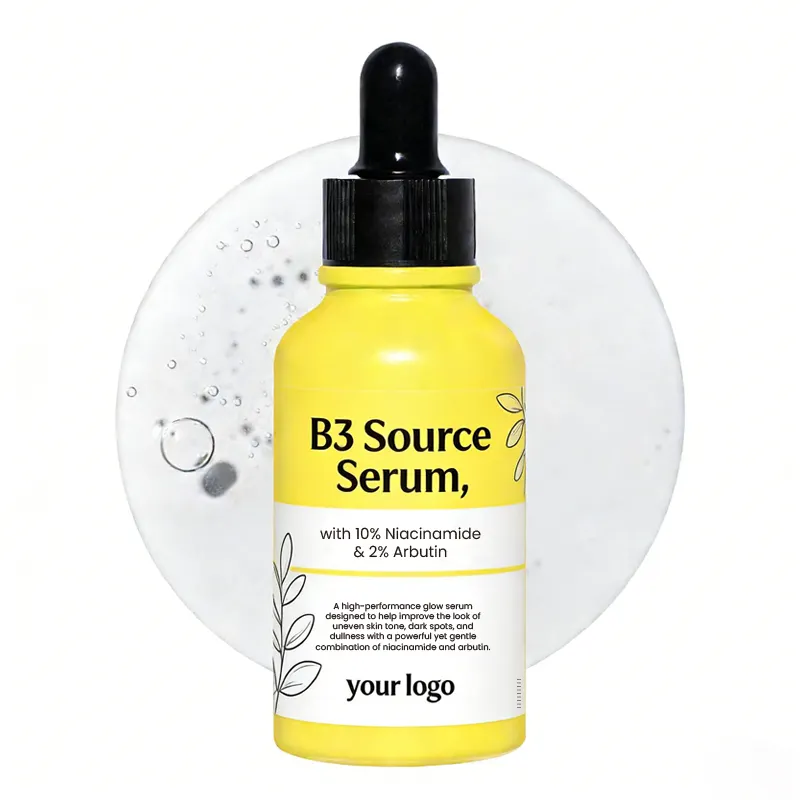
On our 10% niacinamide with 2% arbutin serum, the specification carries both numbers because both are assayed. The niacinamide serum category holds the 2 to 5 percent versions, which is where most briefs should start.
The claim review
In the EU, claims must be supported by evidence and understandable to the consumer. Defensible: “helps reduce the look of uneven tone”, “supports the skin barrier”, “helps control excess shine”. Not defensible: any absolute (“removes dark spots”), any therapeutic framing, or any comparison against an untested product.
In the US, a claim that changes the structure or function of skin pushes the product towards drug status. “Brightens” is cosmetic; “treats hyperpigmentation” is not — and the formula behind those two sentences can be identical.
What to ask before you approve artwork
- Does the bulk assay match the label number, and is that assay on the COA?
- What is the finished pH, and is it buffered or merely adjusted?
- Is there another acid in the same phase?
- What does the colour look like at three months, and does the pack hide it?
For the formulation partner to this guide, see the testing workflow. For an application where niacinamide has a short contact time, read what a wash-off product can honestly claim.
Ask for the assay values on a recent batch through the inquiry form before you approve artwork.
Reference: ISO 16128-1:2016; EU Regulation 1223/2009; internal HPLC assay data

