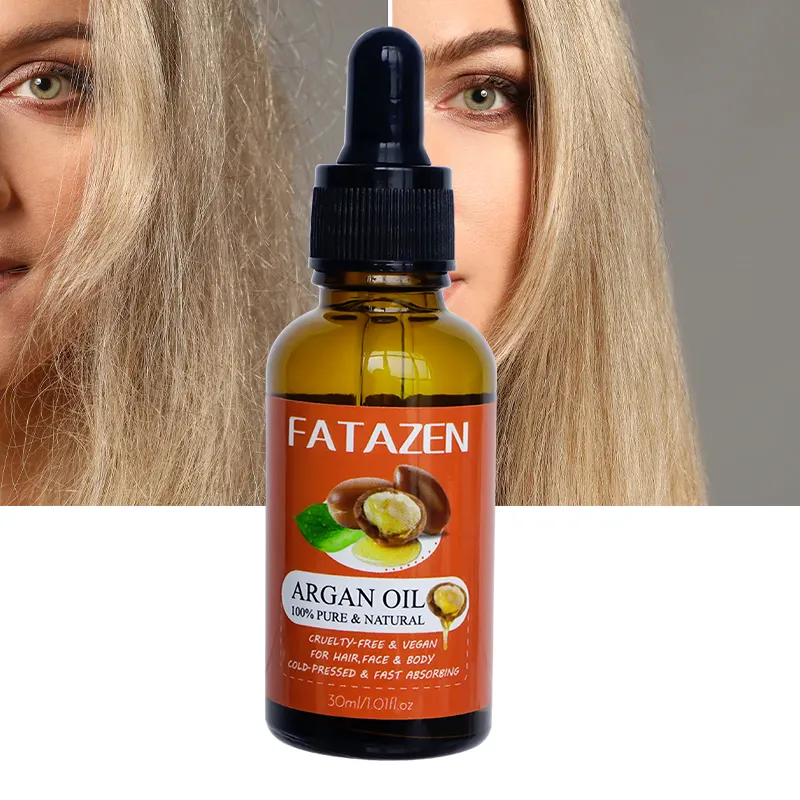
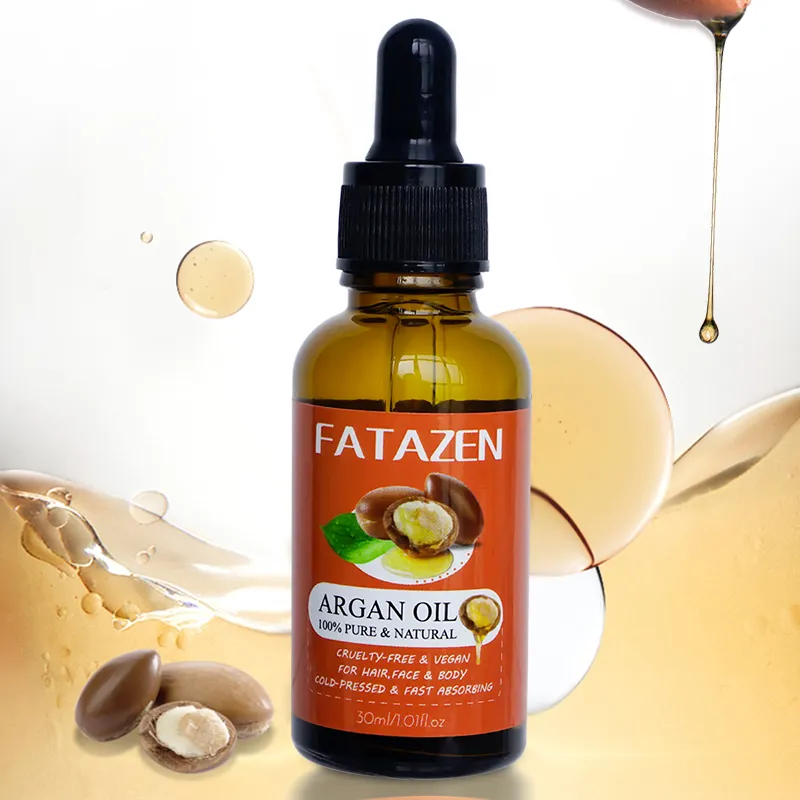
A dropper bottle is a promise about viscosity. The moment a brand chooses a 30 ml glass dropper for a hair oil, it has declared that the liquid will move slowly enough to be counted in drops and quickly enough to leave the pipette between uses. Neither of those is a marketing decision. Both come from a number that appears nowhere on the carton but decides the pack, the fill weight and the feel on the scalp.
For the 100% natural argan hair oil we run as a hair essence oil, that number sits near 40 cP at room temperature. It is not a universal constant, but it is a useful line: it separates a liquid that behaves like a serum from one that behaves like a cooking oil.
What the number is
Viscosity is resistance to flow, expressed in centipoise. Water is about 1 cP; olive oil is roughly 40 to 50 cP at 25 °C; castor oil is closer to 250. A hair oil built on argan, sunflower and a light ester will usually land in the 20 to 60 cP band, which is exactly the band a dropper can meter and a scalp can absorb without a visible film.
Below 20 cP: the ampoule side
Thin oils — mostly volatile carriers and light esters — flow like water. They spread instantly, disappear into the hair shaft and leave almost no residue, which reads as “absorbed” on a consumer test. They are also hard to hold in a dropper: four drops can become six with a tilt of the bottle, and the fill weight drifts upward because the dosing pump cannot cut the stream cleanly. At that end of the range the honest format is an ampoule or a spray, not a pipette.
Above 60 cP: the pump side
Thicker oils — castor, coconut fractions, high-load botanical blends — coat rather than penetrate. They suit a pump or a squeeze dropper with a wide orifice, and they need a longer massage time to avoid a greasy pillow. Above roughly 60 cP a standard glass pipette draws so slowly that the consumer stops counting and starts guessing, and the label instruction becomes fiction.
How it is actually measured
On our line the reading comes from a rotational viscometer with a small-sample spindle, held at 25 °C, after the bulk has been tempered for long enough to lose any heat from mixing. The spindle speed matters: a non-Newtonian oil reads lower at high shear and higher at low shear, so the batch record states the spindle and the speed alongside the result. A certificate that quotes a viscosity without the method is not comparable with anything.
Temperature is the second variable. A 40 cP oil at 25 °C can read near 55 cP in an unheated warehouse in January, and that is enough to slow a filling nozzle and change the fill weight by a few percent across a shift. This is the same arithmetic that governs any liquid fill, and the capsule and serum format guide covers where the boundaries sit for other pack types.
What “100% natural” does to the number
A natural formula cannot lean on volatile silicone to thin itself. Cyclomethicone evaporates after application and gives the dry, weightless finish that most silicone-based hair serums rely on. Remove it and the oil stays on the hair, which is the point of a treatment oil, but it also means the viscosity is set by the plant oils themselves — and plant oils vary by lot, by harvest and by refining.
That variance is why the specification is written as a band rather than a figure. A batch at 36 cP and a batch at 46 cP both pass, and both fill cleanly on the same nozzle, but the second feels richer. Brands that want a fixed feel usually accept a tighter band and pay for more frequent viscosity checks; brands that want a stable cost accept the wider band and adjust the label copy to “rich” rather than “weightless”.
What that means for a 500-piece order
This format starts at 500 pieces with two price tiers, 500 to 1,999 and 2,000 to 4,999, in a dropper bottle or an ampoule. Stock-base samples come out in seven days; a first production run runs 25 to 35 days after artwork sign-off, with a batch COA and a retention sample held for 24 months. The fill and the pack are handled under the same GMP roof, which is the reason a viscosity change is a production decision rather than a purchasing negotiation — the factory page shows the lines and the filling halls.
If the brief is a 30 ml dropper, send the feel you want in one sentence — weightless, silky or rich — and the target band can be set before the first sample. The hair essence oil range shows the other formats we run at this viscosity, and a costed quotation follows from a two-line brief rather than a brochure request: send the quantity and the pack.